a write-up world tour
If we’re doing write-ups for entire groups now, should the crew all get matching shirts???

Hi ya party people,
Not gonna lie, I’m still full from yesterday.
I ate a piece of pie while putting the pie away, which I believe counts as helping clean up, right?! 😅
And if your Thanksgiving was more chaotic than an actual workweek, I hope you at least enjoyed other aspects of it!
Anyway, onto good ol’ Q&A:
First, where do you go for help when you’re the entire HR department and the person you’d normally escalate to is the problem?
And in a 30-person shop, how do you talk a manager out of handing out PPE write-ups for entire groups, instead of just considering a 1:1 approach? 😭
Let’s look at some solutions!
➡️ And if you want a chance to be featured, submit a question here, pls&thanks.
ASK AWAY
📝 superiors & write-upsCopy anchor linkCopied
✍🏾 Where does HR go when they need HR? Especially if it's a one person department?
Context: My superior is the problem and they are the top of the totem pole.
📣 Rosetta Williams, Sr. Director, People Talent & Culture at Immigrant Justice Corps:
This is one of the loneliest spots in the profession, and you're not the first to land in it. A few things that have helped me and others I've coached:
1. Get clear on what kind of "problem" it is. If your boss is difficult, controlling, or just bad at leadership, that's a different situation from one where they're creating legal exposure (harassment, retaliation, wage issues, discrimination). The first you manage and navigate. The second you can't ignore, because you carry professional risk if you stay silent.
2. Document as you go. Keep dated, factual notes: what was said, what was asked of you, who was there. Store them somewhere that isn't company-controlled. Facts only, no editorializing.
3. Find your outside HR. Your peers are your lifeline here. A local SHRM chapter, a forum like this one, or a mentor who's been through it can give you a sounding board you can't get internally. If the stakes are real, a one-time consult with an employment attorney is worth every penny. They can tell you where your own exposure is.
4. Look for who sits above your boss. If there's a board, an owner, or a parent company, there may be a legitimate escalation path. If you go there, frame it around business risk, not personality. "Here's the exposure and here's what it could cost us" gets heard. "My boss is hard to work with" usually doesn't.
5. Know your own limits. Some of this is yours to fix and some isn't. When leadership knowingly overrules sound HR advice, put your recommendation in writing so the decision is clearly theirs to own.
And take care of yourself. Use your EAP if you have one, and keep your resume current. Not because you're leaving, but because options give you steadier footing.
What's the situation? The right next step depends a lot on whether it's behavior or compliance.
📣 Lisa Parra, Principal HR Consultant at RETHINKING HR, LLC | Independent Consultancy:
@Rosetta Williams This and if you have an employment attorney friend in your network, they might be great for perspective. Also, therapy is an underrated resource for HR. Over the years, it has been quite the rock for me.
📣 Alex White, Regional Director, HR at Washington Duke Inn & Golf Club:
I think @Rosetta Williams makes some excellent points, and I couldn't agree more. I especially appreciate the emphasis on building a trusted network outside the organization and recognizing when a situation is beyond our ability to influence.
One of the challenges of working in HR, particularly as a department of one, is that we're often expected to have all the answers, resolve everyone else's problems, and be the voice of reason when things get difficult. But we're human too, and sometimes we need someone in our corner just as much as everyone else - or sometimes even more.
One of the most important lessons I've learned over the years is that we can influence leadership, but we can't always change it. We can provide guidance, advocate for what's right, and do everything within our power to protect our associates and the organization. But ultimately, leadership has to be willing to listen. And having the courage to speak up doesn't always mean having the power to change the outcome.
I would also encourage you to remember that your professional integrity and personal well-being matter just as much as those of the people you advocate for every day. Lean on your professional network, document appropriately, remain true to your values, and don't be afraid to recognize when an environment is no longer healthy for you. There is a difference between navigating a difficult situation and allowing that situation to compromise who you are.
Sometimes the hardest part of being an HR professional is remembering to extend ourselves the same compassion, understanding, and support we work so hard to provide others.
At the end of the day, even those of us who take care of people need people who take care of us.
Safe Space members can join this discussion here. Not a member yet? Apply to join here.

✍🏾 One of the managers wants to do group write ups. Any ideas on how to talk with him about changing his mind to a one on one.
Context: We have 30 employees in the shop. our company is under 150. His plan is to do the morning safety meeting and then give our write ups to anyone without proper PPE. Of course proper PPE is important, but its just as important to have that one on one conversation and try to not make an employee feel called out infront of their peers. The manager thinks that doing this publicly will set the tone. We have great culture here and I worry that this will break that trust with the employees.
📣 Rosetta Williams, Sr. Director, People Talent & Culture at Immigrant Justice Corps:
I’d come at this by agreeing with his goal. He wants PPE compliance to stick and he wants people to take it seriously. That’s legitimate. The disagreement is only about whether public write-ups get him there, and I don’t think they do. I’d walk him through it like this:
1. Public discipline usually backfires on the thing he cares about. People who get called out in front of their peers don’t get more compliant, they get more careful about not getting caught. You also risk turning a safety issue into an employee relations issue, and the whole shop watches how it plays out. With 30 people, everyone will know whose name was called by lunchtime anyway.
2. It creates exposure he may not be thinking about. Discipline is a personnel matter. Handing out write-ups in front of the group can create privacy and dignity complaints, and if enforcement looks uneven, it gives people a “they singled me out” story. Documented, private, consistent discipline is much easier to defend.
3. He can still set the tone publicly, just without names. Keep the morning safety meeting for the standard: “PPE is non-negotiable, here’s what we saw this week, here’s what happens if it continues.” Then handle individuals privately, same day, with the write-up and a real conversation. That gives him the visible message and the accountability without the humiliation.
4. Ask why before you write anyone up. Missing PPE is sometimes a fit, comfort, or supply problem. A one-on-one is where you find that out. A group handout never will.
When you talk to him, I’d skip “this will hurt morale” as the lead. Start with “I want this to work as much as you do, and here’s where I think the group approach could cost us.” Then offer the alternative so he’s not just hearing no. If your culture is as strong as you say, that’s an asset to protect, and he’ll likely hear that better than a policy argument.
📣 Lia Seth, Director of People at Cylinder Health:
Rosetta covered everything perfectly, and I'd follow her advice 100%. The only thing I'd add is that data is your friend here! There are a number of studies you can point to that show that private feedback is shown as a stronger driver of performance and motivation than public feedback. Your shared goal is to get staff to adhere to PPE compliance, and the data shows that having private conversations with individual employees will have a higher success rate than naming and shaming in a group meeting.
📣 Debra Stone, Seeking HR Role at Somewhere Great:
I can relate to what you're experiencing. I worked with a manager who regularly called out employees for performance issues in team chats. Before long, I was dealing with five ER investigations involving complaints of a hostile work environment and retaliation. I used data and the financial impact to help her understand what her approach was costing the department. It took some honest conversations, coaching, and a little tough love, but she changed how she managed her team, and the culture improved.
Safe Space members can join this discussion here. Not a member yet? Apply to join here.
🚨 ON YOUR RADAR
🎧 I'm still out of office in my heart, but I hope you had a good Thanksgiving and that your first meeting back gets canceled. If it does, may I suggest spending that glorious little gap with me on my latest podcast episode? Check it out on Spotify or Apple Podcasts!
🗓️ I checked my calendar for professional development time and found a meeting about why nobody has time for professional development. Join me for HR Therapy on Dec 16th, and we’ll figure out what you want to learn in 2027 and where the hell it’s supposed to fit.
💰Pay Transparency matters (but it's also difficult). That's why I created this course. Join the Safe Space community to access it, plus everything else you need to stay ahead of the curve.
📝 RESOURCE OF THE WEEK
Each week I feature a resource I love from the Safe Space library that I believe would be relatable to this week's newsletter topic.
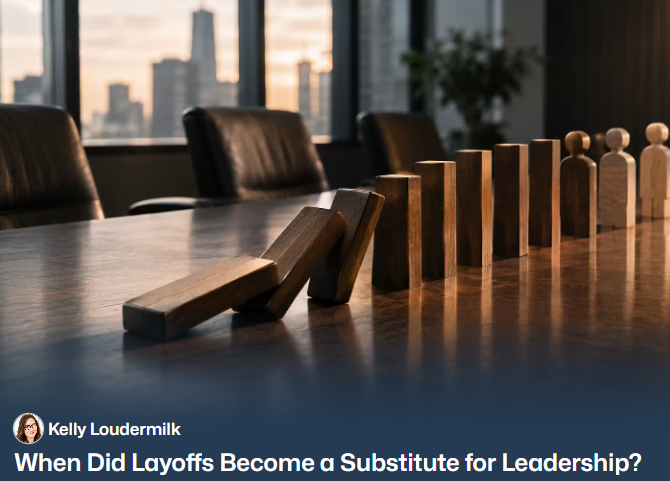
Today, we’ve got layoffs and leadership. Check it out HERE ⬇️
🫂 COMMUNITY CORNER
🎄CHARLOTTE AREA - December 4th, 5pm! Our first-ever holiday meetup is here and we’re getting crafty. Come hang with fellow Safe Spacers + your community manager Kat at PlantHouse in Charlotte to build your own terrarium or pour a custom candle. It’s on Safe Space 💅 Only 10 seats, so grab your spot 👉 here!
☃️ DC AREA - December 16th, 6pm! Let’s close out the year right. Come hang with Hebba and fellow Safe Spacers at Flor Coffee + Books for an end-of-year game night with Argentine wine, empanadas, sweet treats and some of your fav ppl. It’s on Safe Space 💅 There are ONLY 20 spots, so if you know you can make it grab your spot 👉 here!
FRIDAY FUN
😂 i'm ooo Copy anchor linkCopied
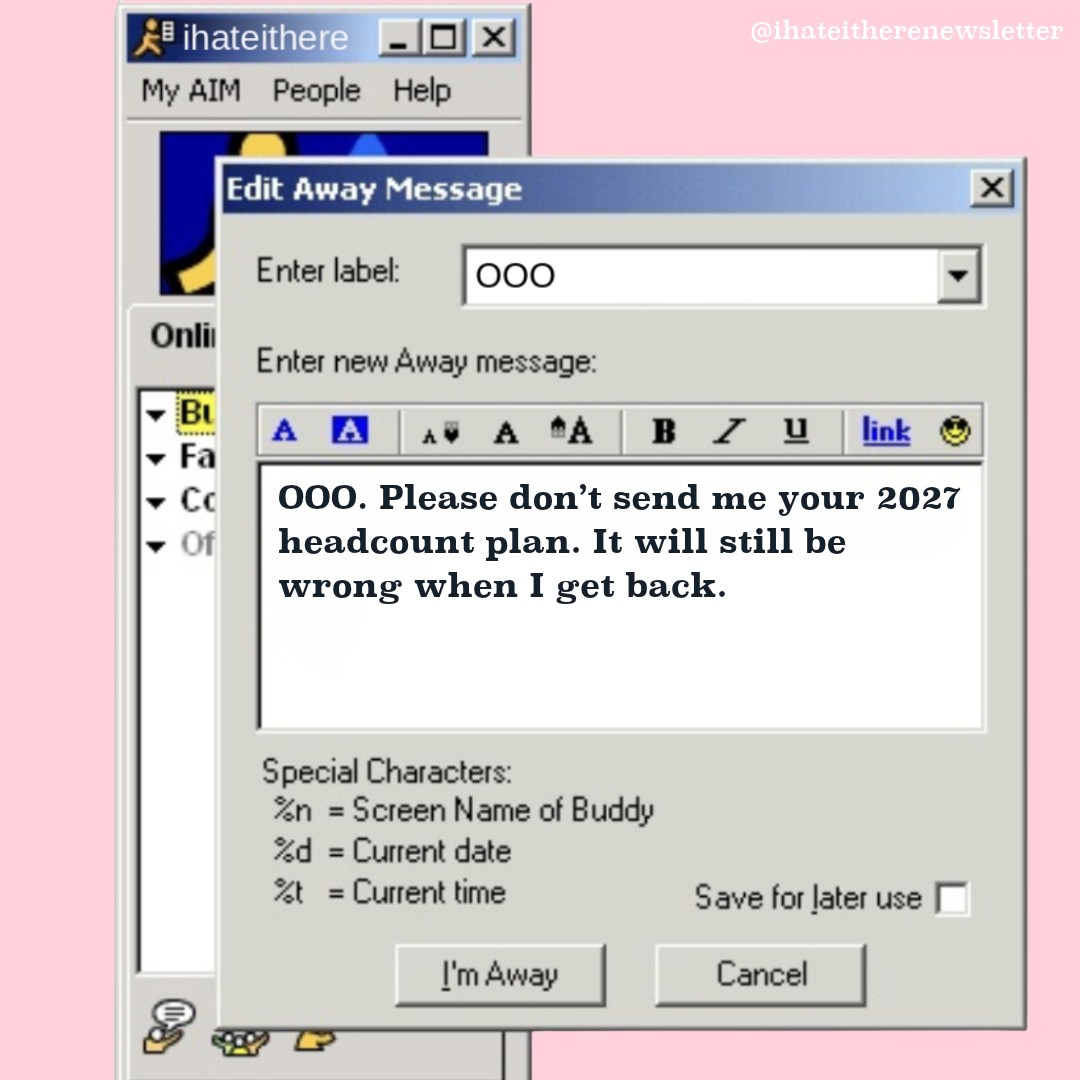
Motion to bring back AIM away messages!!!!
That's all for this week! I hope you enjoyed! If you have any thoughts, please let me know. I'm allll ears.
Reminder: Today is FRIDAY. 🙏