evals & energy vampires
Hiiiiii friend,
It's Friday, I'm exhausted!!
Why you may ask?? Well, I had an adventure this week!
🚊I keynoted an HR conference in NYC then spent 6 hours on the train trying to get back to DC!!!! For context the trip usually takes 2.5 hours. The Amtrak employees were sooo great during this entire ordeal, honestly they deserve all the flowers this week. The power went out on our train so they had to get us off our train and onto another. They made a makeshift bridge to have us walk over to get to a train that pulled up next to ours. The entire ordeal was entertaining yet draining. I couldn't believe what was happening. Just another day on the Acela I guess?!
Now onto another type of adventure, Dear Hebba & Friends!
This week’s Q&A is serving up two spicy workplace dilemmas: one about getting screwed by a "meets expectations" rating when you’re clearly doing the most, and another about surviving an employee who sucks the joy out of the room.
So let’s get into it, and don’t forget to submit your questions for a chance to be featured on a future edition! 👀
ASK AWAY
🔎 expectations & rantsCopy anchor linkCopied

✍🏾 I’ve taken on responsibilities and projects beyond my original role, but my evaluation still came back as “meets expectations.” How can I ensure that the extra work I do is reflected in my performance ratings and compensation?
Context: Global corporation, healthcare, for profit
📣 Erin Bennett, Manager of Talent @ Woods Hole Oceanographic Institute:
I think we need a little more context to help guide you here... do you have specific KPIs, goals and expectations that your manager reflected on in your written review? Do you also have the opportunity to produce a self-evaluation during your review cycle to advocate for your additional work?
In any case, it's critical for you to speak up and get clarity around all aspects of this. I think sitting down with your manager (and/or possibly an HR representative) is vital for you going forward to understand:
What WAS expected of me prior to taking on additional responsibilities and projects?
Was there an inherent (whether it was implied or actually documented) increase in your expected outcomes/goals/etc... based on the additional work?
Does your original job/job description include anything like: "ad hoc duties and projects as assigned"? This is often an easy way for supervisors to tack on unclear additional responsibilities and not be held accountable for any additional "reward."
How can you and your manager work better together going forward to ensure you are both on the same page when it comes to expectations at the beginning AND end of the review cycle?
📣 Jessica Connelly, VP, Manager of Culture & Employee Engagement @ First Bank of the Lake:
I often share with people that the more ongoing performance-related conversations you have, the better performance will be, regardless of whether you're celebrating champion work or coaching for increased performance. So, I'd encourage you to reach out to your supervisor and say, "Over the next year, I want to blow your expectations out of the water. Can we set aside one hour (or 30 minutes) to discuss performance on timely projects, tasks, and initiatives, every other month? "
Be willing to send the calendar invite yourself, so it doesn't get overlooked. Be highly open to compliments, feedback, and coaching during those conversations. The goal is to get a good read for your performance level and an indication of when and where you can turn up the heat, to knock their socks off.
📣 Sarah Aziz, Director of DEAI Initiatives @ Pittsburgh Cultural Trust:
Is your company culture one where "meets expectations" is akin to mid or does it mean you're doing exactly what we expect and we value and appreciate it? Is exceeds expectations like getting a purple heart or are they thrown around like confetti? Most importantly, were your expectations clear? And were your manager's expectations the same as yours? Is it possible they were expecting you to take on the additional work that was put on your plate but didn't tell you in advance so you feel like you've been going above and beyond and they feel like you're doing your job?
I hate to be a broken record in my advice but when I break down these questions, communication is often at the root. Have a chat and see where things shake out. And I agree that if you go in with data and metrics, it'll strengthen your case.
Safe Space members can join this discussion here. Not a member yet? Apply to join here.

✍🏾 How do I handle an employee who is draining me of all sanity due to constant rants and nonstop negativity? I work for an institution that protects itself and employees like this so I have to be nice and it's literally killing me!
Context: N/A
📣 Inas Laghzaoui, Head of HR & CSAT @ CE Brands International:
I've been in this situation so many times! It's tough trying to do the right thing without getting your boundaries pushed aside, but there are ways to approach this constructively. First, it’s important to understand the root cause of their complaints. Are they feeling alienated or unheard? Do they lack proper outlets for their grievances? Taking the time to ask questions like, “What’s been bothering you most?” or “What do you think would help improve this situation?” can help uncover whether their negativity stems from a deeper issue or if it’s simply habitual. Additional context is key to understanding what exactly they are ranting about.
If their complaints are not tied to legitimate concerns, you can try the following, it's my usual go-to for situations like these:
- Address the Impact: Clearly explain how their negativity affects their work and the team. For example, “When you focus on complaints, it impacts team morale and collaboration, and it can take time away from your tasks.” You can also explain how this behavior chips away at resources everyone benefits from. This helps them see the broader consequences of their actions.
- Set Clear, Measurable Goals: Instead of tracking “complaints,” focus on actionable behaviors. For instance, “When raising concerns, please also suggest potential solutions,” or “Let’s limit venting to a specific time during our 1:1s and then shift to action steps.” This keeps the feedback constructive and manageable.
- Offer Support: You're not their therapist, I highly suggest that you orient them towards resources like an EAP or other support systems. Additionally, consider creating a structured space for feedback, such as a monthly meeting where employees can share concerns productively. This can foster psychological safety and provide a healthy outlet. Think of it as a support group in a sense.
- Follow-Up: Regularly check in to assess progress and ensure the changes are sticking. If there’s no improvement and they’re unwilling to grow, it may be time to evaluate whether this is the right workplace for them, as managing their impact on others can become unsustainable. Nothing spreads faster than negativity.
Balancing empathy with accountability is key here. When addressing the ranting, offer support and clear expectations but don't compromise your own mental health or the team's morale. Sending you all my love, You got this!
📣 Josiah Hernandez, People Operations & Recruiting Manager @ CW Financial Services LLC:
This is a difficult situation – and honestly, I've found myself in a similar spot so I’m still figuring it out too. Like what others have said and what has personally helped me is learning how to set some emotional boundaries. I try to stay kind and empathetic, but I’ve realized sometimes the other person just isn’t interested in solutions, and I can’t let that completely drain me. I still want to hear them out, but want to close the door on a free-for-all complaint session, so I’ve learned asking things like, “What kind of support do you actually need right now" helps to gently steer the convo away from that opportunity.
What we both have to remember is that being nice doesn’t mean you have to absorb constant negativity. Someone else also said this: you're not their therapist. When I need a reminder, I always think of the Meredith Marks gif of her saying "Thank you, I'm disengaging!" to make me smile and move on.
📣 Devinne Jackson, HRBP @ Wildlife Computers :
1. Set Clear Professional Boundaries: It’s okay to be kind and firm. You can acknowledge the employee’s concerns without absorbing their emotional load. Set limits on time and tone to protect your capacity.
2. Shift the Conversation Toward Solutions: Constant negativity often stems from a feeling of helplessness. Reframing the discussion around possible actions or what is within their control can help disrupt the cycle.
3. Take Care of Yourself: Protecting your energy isn’t selfish – it’s responsible. Create space in your day to reset, debrief with a peer if appropriate, and give yourself permission to step back when needed.
Safe Space members can join this discussion here. Not a member yet? Apply to join here.
🚨 ON YOUR RADAR
🎧 I Hate It Here Podcast: Corporate America’s DEI performativity is exhausting, so I brought in the amazing Cierra Gross (Founder of Caged Bird HR & Wrk Receipts) to drag the lies, call out fake "accountability," and spill why Gen Z is the workplace reckoning we needed. Check out the full episode on Spotify or Apple Podcasts!
👩🏽💻 Writing Job Posts Using AI: my friend Kat Kibben is hosting a session on May 14th at 1PM ET on how to write job posts that actually make sense leveraging AI! Leave JDs that make no sense in the past and optimize your JDs to reach the talent you're looking for!
📺 Built to Scale, Paid to Stay: HR Therapy on May 28th at 1PM is going to cover your juiciest questions about what is going on in the world of compensation. Trust me, there's so much data to unpack to give you a clearer sense about what we're experiencing in this market.
🧠 Tough Times, Strong Minds: Safe Spacer Stephanie Lemek is hosting a star studded panel on May 28th at 2PM ET full of some of my fave people and fellow Safe Space members. Julie Turney, Jenn Laurie, and Jessica Winder??? You have to attend because these folks have a wealth of knowledge to share.
♥️ From ‘I Hate it Here’ to ‘I Love it Here’: Your Culture Transformation Roadmap. HR can influence culture change in any organization, and this course teaches you how. Join the Safe Space community to access it!
📝 RESOURCE OF THE WEEK
Each week I feature a resource I love from the Safe Space library that I believe would be relatable to this week's newsletter topic.
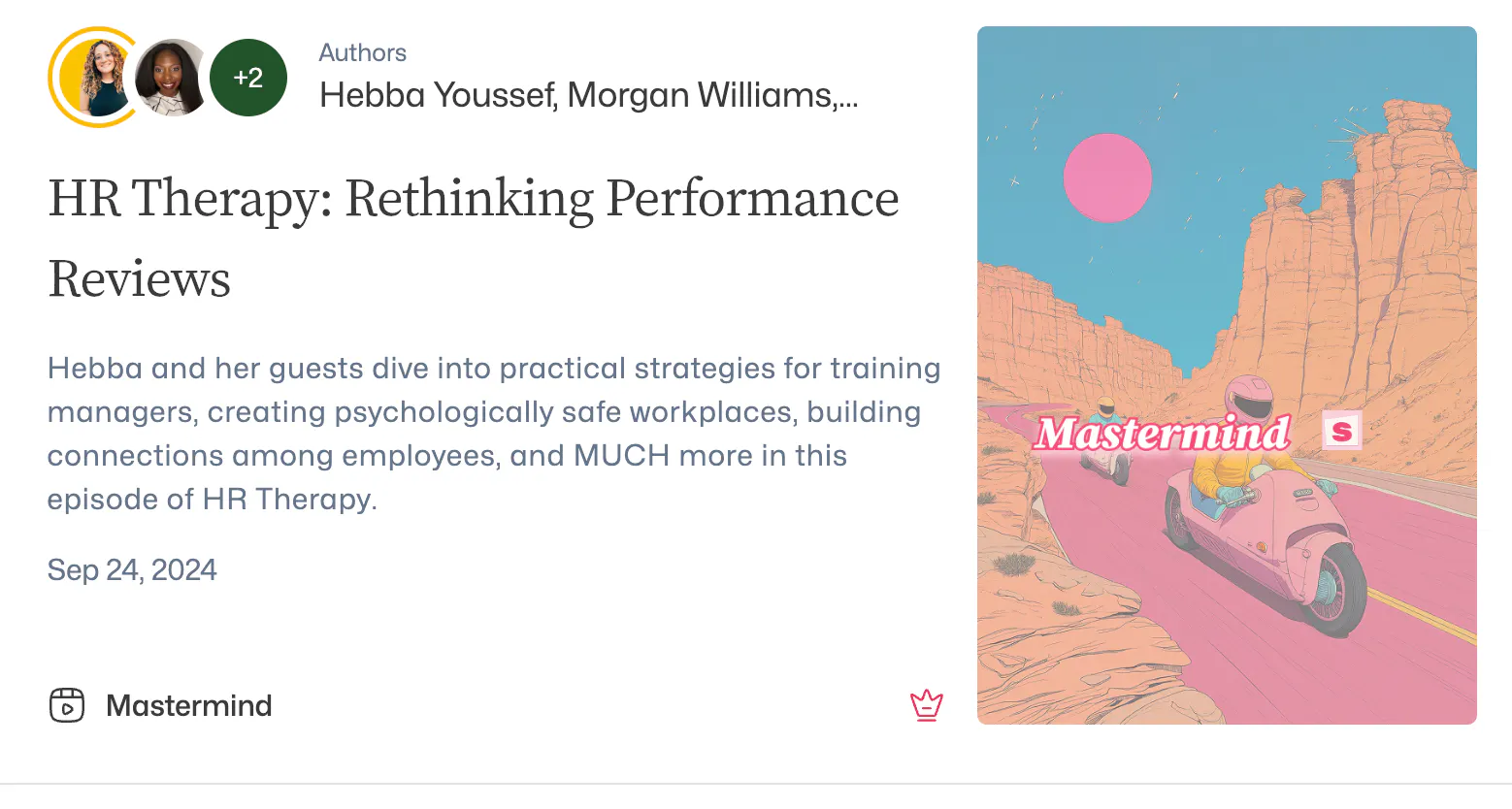
This week, I’m throwing it back to my HR Therapy session with my friends Morgan Williams, Ruthie Garelik Berson, and Stephanie Lemek. We chatted all about performance reviews, practical strategies for training managers, creating psychologically safe workplaces, building connections among employees, and more. Check it out HERE ⬇️
FRIDAY FUN
👀 moving on!!!!!!Copy anchor linkCopied
.png)
Listen, I love to yap just as much as the next person but when it starts to get into the personal... it's time to PIVOT.
Ever find yourself in a situation and think, well that's something I didn't need to know...
ME TOO.
That's all for this week! I hope you enjoyed! If you have any thoughts, please let me know. I'm allll ears.
Reminder: Today is FRIDAY. 🙏