HR knows…and???
If HR and the manager are both aware of the problem, why is nothing being done about it?

Hi ya party people,
Super pumped that next week is a short one because of Thanksgiving, which means we all have some time off to look forward to!
I’m already emotionally unavailable for anything described as a quick sync before the break, but I am ready for some Q&A! 😇
We’ve got a reader on a job hunt, looking for the best way to hear back from a hiring manager that promised an update and didn’t give one, and another reader that wants to know what they can do about a coworker’s toxic behavior when HR already knows and the manager seems perfectly happy to let everybody else deal with it.
📝 Never a dull moment over here, y’all! So if you have a question you want the community to tackle, you can submit it here.
And before you go...I’m running a lil poll in Safe Space about whether getting rid of job titles is a good idea or a bad idea. Go vote real quick if you haven’t! 🙏
ASK AWAY
🧠 the right behaviorsCopy anchor linkCopied

✍🏾 Im in a job hunt, and I dont want to wait for the recruiter to ghost me after the first interview. So I have this new modus operandi to wait until the date the recruiter told me I would receive news back, to send an email directly to the hiring manager or my direct report. This email has my plan 30-60-90 days plan, or my unique approach to the role.
I have only done it twice, and the first time got me a second (and final round) interview with the direct report. But I wonder how much backfire this could have. I need to find ways to stand out, but I want to hear from the HR or recruiters side to this proactive and annoying approach from my side.
Context: The job hunt is brutal.
📣 Caroline Balter, Senior HR Manager at Third and Grove:
Few people send thank-you emails to each person they've met with, and I think that could have the same or better results. There might not be a great way of knowing if your 30/60/90 plan aligns well enough with the business or whoever will be supervising you. It's frustrating when recruiters ghost. Recently I had one send me a decline to my 'application' after I actually met them live. I understand the gap you're trying to overcome there. Build a rapport in the first few minutes with the recruiter, letting them redirect the conversation to the interview as they need.
Do the same thing with everyone you meet, trying for a little small talk. That combined with a genuinely good fit will get a good recruiter to usher you through the process better, and it gives you a more flexible foundation. I think some people are afraid HR will come in and take over or force ideas that don't fit the business, and that would be my hesitancy with sending over a full plan before getting to know the landscape.
📣 Rachel Diskin, HR and Operations Consultant @ Big Change Consulting:
This job market IS brutal! Kudos to you for thinking creatively about how to stand out.
I second Caroline's sentiment that a thank you email in itself could have the same or better results. I don't love the idea of putting in work for an organization before they've hired me, and your 30/60/90 plan probably takes a lot of effort on your part.
Here's what I do: In my thank-you, I find something we talked about that I can showcase my previous work, and link that to how I'd be successful in their role.
For example, if they mention they're going through a lot of change, I'll share the one-pager I created to show the results of a change-saturation listening tour I led. If they need someone to drive internal comms, I'll share an example of the internal newsletter I created. And I always make sure to mention specifics about our conversation to link it all together.
That shows you were listening and thinking critically. But it doesn't require you to do any extra work :) Good luck out there. You got this!
📣 Alex White, Regional Director, HR at Washington Duke Inn & Golf Club:
I think Caroline and Rachel both make some excellent points, and I'll offer a slightly different perspective from someone who has spent many years on the hiring side of the table.
First, I appreciate the initiative. The job market is incredibly challenging, and I certainly understand wanting to find ways to stand out. Personally, I would never consider a thoughtful, professional follow-up annoying. In fact, I appreciate candidates who demonstrate genuine interest and take the initiative to distinguish themselves.
That said, I think there's a fine line between being proactive and potentially overstepping. A 30-60-90-day plan can be impressive, but it can also be premature when you haven't had the opportunity to fully understand the organization's culture, challenges, resources, or expectations. Sometimes the best way to demonstrate your value is to show that you're willing to listen and learn before proposing solutions.
I also wouldn't necessarily recommend going around the recruiter to contact the hiring manager unless you've already established that relationship or have been encouraged to communicate directly. Not because there's anything inherently wrong with reaching out, but because every organization approaches its hiring process a little differently.
My suggestion? Send a thoughtful follow-up that references something meaningful from your interview, reinforces the value you could bring to the position, and perhaps shares a brief insight into how you would approach a particular challenge discussed. You can demonstrate initiative without giving away an entire playbook.
And one final thought from the HR side - Candidates shouldn't have to develop elaborate strategies just to receive basic communication from employers. If we tell someone they'll hear from us by a certain date, we should make every reasonable effort to honor that commitment, even when the answer isn't what they hoped for. That's simply showing respect for someone's time.
Keep being proactive, but don't underestimate the value of being authentic. The right employer should appreciate both your initiative and your professionalism.
Safe Space members can join this discussion here. Not a member yet? Apply to join here.
✍🏾 What if HR is aware of an employees toxic behaviour and their manager turns a blind eye to it, is there anyway to get it to stop?
Context: Healthcare industry - 2000 employees in Canada.
📣 Kristen Colley, Director of HR @ Summit County Court of Common Pleas:
I have found that often times managers don't address behavior issues because they don't know how. I would conduct an investigation and present the manager with the facts of the investigation then walk through the possible consequences of inaction and offer viable solutions to the problem. If the manager is turning a blind eye, the employee may not even know that their behavior is toxic! So, teaching managers how to tackle behavior or performance problems is key. It also sets the expectation that issues need to be dealt with, not swept under the rug.
📣 Rosetta Williams, Sr. Director, People Talent & Culture at Immigrant Justice Corps:
Yes, but you have to stop treating it as an employee problem and start treating it as a manager accountability problem. HR knowing about it isn’t enough. Once the manager’s inaction is the issue, you have more leverage.
1. Check whether you already have a legal obligation to act. In Canada, most provinces and the federal jurisdiction require employers to address workplace harassment and violence under OHS legislation (Ontario’s OHSA, BC’s WorkSafeBC policies, Quebec’s psychological harassment provisions, Canada Labour Code Part II). If anyone has raised a complaint, formal or not, the employer has to respond. The manager doesn’t get a vote on that. If your policy says HR investigates, investigate.
2. Document everything. Document the behaviour, who’s affected, what the manager was told, and what they did or didn’t do. That paper trail is your protection and your case.
3. Escalate over the manager’s head, and frame it as risk, not personality. Take it to their director or VP. Don’t say “this person is toxic.” Say “we have a known issue, the direct manager hasn’t acted, and here’s our exposure.” In healthcare that exposure is real: turnover and burnout in an already stretched workforce, patient safety and quality of care, grievances, WSIB/WorkSafe claims, and potential constructive dismissal or reprisal claims.
4. Make the inaction visible. A manager who ignores a known problem has made a decision, so put it on record that way. Leaders often move quickly when they realize “we didn’t know” is no longer available to them.
5. Look for your other levers. In a unionized setting, bring in labour relations. If the person is a regulated professional, there may be reporting obligations to their college. A neutral third-party investigation also takes the matter out of the manager’s hands.
Be realistic, though. If leadership won’t back HR, there’s a ceiling on what HR can do. At that point your job is to make sure the risk has been clearly communicated and the decision to do nothing is knowingly owned by someone with the authority to make it.
📣 Luke Willman, Engagement & Culture at St. Elizabeth Healthcare & St. Elizabeth Physicians:
I think @Rosetta Williams NAILED it... once a manager turns a blind eye, you stop treating this as an employee behavior problem and start treating it as a manager accountability problem. In a 2,000-person healthcare system, the manager doesn't get a vote when patient safety, burnout, and statutory compliance are on the line.
To take it a step further, have you considered auditing the operational incentives rewarding the blindness? In healthcare, managers rarely ignore toxic behavior just because they lack conflict resolution skills. They ignore it because replacing a clinical or operational body is an immediate operational nightmare. When a unit is short-staffed, a manager will gladly tolerate a toxic high-producer to avoid working a double shift themselves or tanking their department's throughput metrics.
If HR wants the behavior to stop, don't just hand the manager a coaching script or threaten escalation. Take the staffing fear off the table. Partner with Talent Acquisition to build a warm pipeline or float-pool backfill before the manager pulls the trigger on accountability. Managers protect toxic employees when they feel like the cure is worse than the disease. Remove the operational penalty of holding someone accountable, and you'd be surprised how quickly that manager will find their backbone;)
Safe Space members can join this discussion here. Not a member yet? Apply to join here.
🚨 ON YOUR RADAR
🎧 Turns out binge-watching Judge Judy qualifies me to have VERY loud opinions and exactly zero answers about a hiring bot in court! So I brought back Val Jensen, a lawyer who’s worked in HR, to help me unpack three real cases and figure out what I’d double-check in my own HR processes. Check it out on Spotify or Apple Podcasts!
📝 Quick question for everyone who wrote a development plan this year…who wrote yours??? Join me on Dec 9th for our last HR Therapy of the year, where we’ll make a plan for what YOU want to get better at in 2027. And yes, we’re talking about how to make time for it when everyone’s quick asks are already eating your calendar.
🔎 "Good vibes" is not feedback. Spark Hire’s free Hiring Manager Feedback Cheat Sheet gives managers five post-interview questions, real feedback examples, and a quick checklist...because HR has enough to do without translating a thumbs-up into a hiring decision.*
❤️ From ‘I Hate it Here’ to ‘I Love it Here’: Your Culture Transformation Roadmap. HR can influence culture change in any organization, and this course teaches you how. Join the Safe Space community to access it!
*This one is brought to you by one of my amazing brand partners
📝 RESOURCE OF THE WEEK
Each week I feature a resource I love from the Safe Space library that I believe would be relatable to this week's newsletter topic.
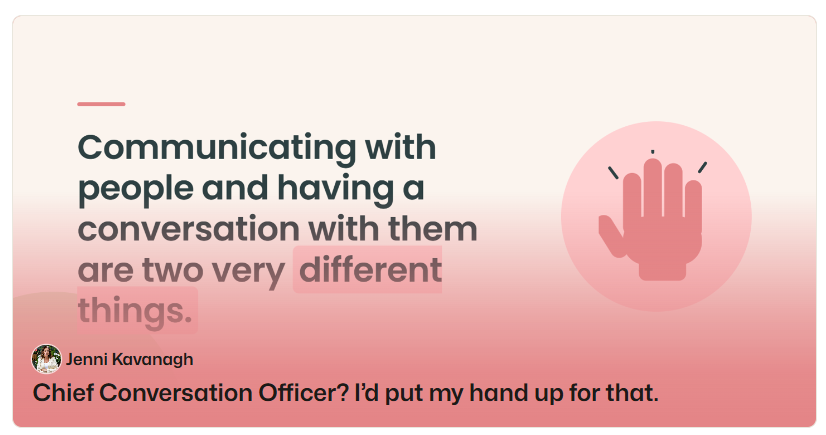
Today, we have a distinction between communication and conversation. Check it out HERE ⬇️
🫂 COMMUNITY HAPPENINGS
In-person Meet-ups:
🎄CHARLOTTE AREA - December 4th, 5pm! Our first-ever holiday meetup is here and we’re getting crafty. Come hang with fellow Safe Spacers + your community manager Kat at PlantHouse in Charlotte to build your own terrarium or pour a custom candle. It’s on Safe Space 💅 Only 10 seats, so grab your spot 👉 here!
☃️DC AREA - December 16th, 6pm! Let’s close out the year right. Come hang with Hebba and fellow Safe Spacers at Flor Coffee + Books for an end-of-year game night with Argentine wine, empanadas, sweet treats and some of your fav ppl. It’s on Safe Space 💅There are ONLY 20 spots, so if you know you can make it grab your spot 👉 here!
Must Attend Virtuals:
☕ December’s Virtual Coffee + Cowork on Dec 16th, at 1:00 PM EDT is now live! HR team of 1? In need of body doubling? Simply want to hang out listening to lofi beats with your fav community? Trust, it’s always a vibe. Come hang with your your ppl, grab your spot 👉 here!
FRIDAY FUN
😂 help me find what i lostCopy anchor linkCopied
Pls let next week be short & sweet.
IM READY FOR THESE HOLIDAYS AKA DAYS OFF!!!!
Reminder: Today is FRIDAY. 🙏 Have a FAB weekend!