leaders misbehaving
Hi ya party people,
Our favorite day of the week is here!! 🤩
I, for one, am counting down the days that I get to wrap up in a festive blanket, watch Stranger Things, and justify the amount of sweets I may or may not enjoy during the holidays. Let me liveeeee.
Anyway, I hope you’re sipping something warm, because today’s questions came in hot.
And by hot, I mean “a department head is detonating culture from the inside” and “leadership is stuck in 1998 but wants 2025 results.”
Basically, my favorite horror genre: corporate chaos wrapped in denial.
So let’s discuss!
Loving the question submissions BTW! KEEP EM COMING! Submit yours here for a chance to be featured in the newsletter.
ASK AWAY
👀 leaders & accountability Copy anchor linkCopied

✍🏽 How do you repair a company culture when one of the department heads/owners is creating a toxic work environment aka silo-ing her department from everyone else but blames everyone but herself.
Context: We're a small company, with a total of 50 people across three locations, with the majority based at our Headquarters. We have worked hard over the past five years to create a welcoming and inclusive company culture - and it was working - until about 12 months ago. Our new department head and minority owner is starting to create major toxicity within the company. Most of us wear too many hats, including our CEO, who, up until this point, has been an ostrich about the situation (buried his head in the sand). From an HR standpoint, how can you guide the CEO and this Department Head back to the fold? Or is it too late? If this person leaves, most likely their entire department will leave.
📣 Jessica Simmons VP, HRBP @ ICD:
In small, growing companies, leaders often operate as “builders” (heads down, owning everything, and moving fast) which can accidentally create silos as the company scales. This situation is an opportunity for the CEO to shift from building to coaching, especially with a department head who may not realize she’s creating a toxic, isolated environment.
Most leaders who silo themselves are often reacting to pressure, past workplace norms, or a belief that control equals stability. Approaching the conversation with curiosity and empathy allows the CEO to understand her perspective while also signaling that the company’s culture needs protecting. Framing the discussion around values (not blame) helps lower defensiveness, e.g., “We’ve built a culture of openness and collaboration, and when any team becomes isolated, it can unintentionally erode that foundation.”
Your role is to help the CEO flex his coaching muscles and follow through. Equip him with talking points grounded in understanding (e.g., “help me see the challenges from your perspective”), impact (e.g., “other teams are feeling disconnected from yours”), and forward momentum (e.g., “you’ve built a strong team; now let’s expand your influence across the organization”). Set clear expectations and create a support structure of check-ins and cross-department touchpoints so the CEO doesn’t slip back into avoidance. It’s not too late to repair the culture because the real shift happens when leadership re-engages and models the behavior they expect.
📣 Rosetta Williams, Sr. Director, People Talent & Culture @ Immigrant Justice Corps:
This requires immediate CEO intervention, and your job is to ensure that inaction impossible.
Start by reframing this as a business risk, not just an HR concern. Document:
- Specific examples of siloing and operational impact
- Employee concerns (anonymized where needed)
- Retention risk across the organization (beyond just that department)
- How this erodes five years of culture investment
- Legal exposure from toxic behavior
The ownership stake complicates this significantly. You can't use traditional performance management, so this requires a CEO-to-owner conversation about partnership expectations and organizational health standards.
Key diagnostic questions:
- Does this person acknowledge any problem exists?
- Will your CEO have a direct, consequential conversation with an owner?
- What does your operating agreement say about owner accountability?
- Is the whole department truly loyal to this person, or are some trapped by the dynamic?
On the exodus fear: Organizations often overestimate this risk. Consider whether the cost of keeping toxic leadership exceeds the cost of rebuilding with healthy leadership. You might retain more department members than expected once the toxic influence is removed.
If there's appetite to try repair:
- Outside intervention (executive coach, mediator, consultant) - you can't solve this alone
- Clear behavioral expectations with timeline and milestones
- CEO must own the accountability conversation
But be honest with your CEO: Given the ownership stake and 12 months of pattern, separation planning may be the realistic path. What does your gut tell you about salvageability?
📣 Nalini Mani, Organization Transformation Advisor @ N/a:
Repairing culture in this situation is challenging but not impossible. The first step is to re‑engage the CEO, because culture repair must be led from the top. Right now, the CEO’s avoidance is unintentionally signaling acceptance of toxic behavior. A gentle but firm approach works best: frame the issue as a business risk rather than a personal conflict.
Share data on turnover, morale, and productivity to make the impact visible. Invite the CEO to see himself as the steward of the culture he helped build, and remind him that employees look to him for alignment and accountability. Position this as an opportunity for him to reassert leadership and protect the company’s values. Once the CEO is engaged, a structured conversation with the department head is essential. As both a leader and minority owner, she must align with the company’s values.
Coaching and mentoring can help her understand the impact of siloing and blaming others, but expectations must be clearly set and documented. At the same time, the company should reinforce its culture across all teams by revisiting values, encouraging cross‑department collaboration, and empowering managers to uphold inclusivity. Finally, contingency planning is critical: if she chooses not to change and departs, the company should be prepared with retention strategies for her team. It is not too late, but decisive leadership action beginning with the CEO’s re‑engagement is required to bring the department head back into alignment and protect the culture you’ve worked so hard to build. At the end of the day one has to be decisive and act.
Safe Space members can join this discussion here. Not a member yet? Apply to join here.

✍🏽 How can I promote an inclusive culture and onboarding process when our leaders are resistant and outdated, and we have a new HR Director who is even less professional than the previous one?
Context: This is a property management company with about 300 employees. We have 6500 units across ten states.
📣 Jessie Fields, Sr Director, People Strategy & Ops @ C2FO:
Tell a story using the data! How is attrition within a new hire's first year? What is performance looking like at 6 months, 1 year? Identify the biggest gaps and show how an improved onboarding experience could help close them. And then show leaders how this will help make their jobs easier (e.g., a clear onboarding plan will improve time to productivity and reduce the amount of oversight they need to have, saving them time in the long run). Being able to articulate What's In It For Me (WIIFM!) for those who are resistant, will help them warm up to the idea.
📣 Anonymous @ N/A:
You fix it by building undeniable proof that a better way works. Start small: redesign one piece of onboarding that’s fully within your control (a clearer Day One roadmap, a buddy system, or a simple cultural norms guide) and track the impact on retention, engagement, or ramp time.
Leaders who won’t listen to values will often listen to outcomes. Document what’s broken, pilot what you can, and socialize early wins so the old-school crowd can’t ignore the results. And when your HR Director isn’t elevating the bar, become the quiet architect who does.
Safe Space members can join this discussion here. Not a member yet? Apply to join here.
🚨 ON YOUR RADAR
🎧 Workplace culture quietly rewires your entire personality. Jessie Stettin and I also dig into how your childhood is still crashing your 1:1s. If you’ve ever wondered why you lead or spiral the way you do at work…yeah, it’s all connected. Check it out on Spotify or Apple Podcasts!
💰 Pay Transparency matters (but it's also difficult). That's why I created this course. Join the Safe Space community to access it, plus everything else you need to stay ahead of the curve.
🤖 What happens to HR when AI gets human? SAP’s new report explores how HR leaders can stay human and strategic in the age of AI, because good work isn't humans vs. AI, it’s humans with AI.*
*This one is brought to you by one of my amazing brand partners
📝 RESOURCE OF THE WEEK
Each week I feature a resource I love from the Safe Space library that I believe would be relatable to this week's newsletter topic.
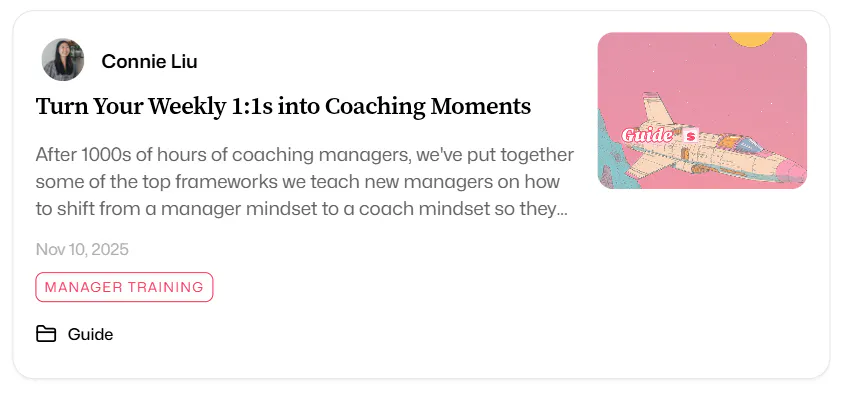
This week, we’ve got coaching moments made from 1:1s. Check it out HERE ⬇️
FRIDAY FUN
🔥 ohhh boyyy buckle up folksCopy anchor linkCopied
_56xe.png)
If you did not see the verdict, you can read more here.
The recap: an $11.5M dollar fine in a racial discrimination case.
brb buying the transcripts so stay tuned.
That's all for this week! I hope you enjoyed! If you have any thoughts, please let me know. I'm allll ears.
Reminder: Today is FRIDAY. 🙏