one word: clueless
Hi ya party people,
Congratulations on completing surviving another week of adulting! ⭐
You deserve a gold star, or at least a pat on the back, especially if you dealt with any toxic leadership this week.
Every HR leader I know has had at least one toxic boss. It’s a rite of passage, unfortunately!
Which leads me to this week’s questions... a double feature in frustration.
First up: what happens when ownership doesn’t know how to manage their managers, and HR ends up carrying the company on their back?
Then we’ve got the timeless classic: being hired for your expertise only to be left out of the actual decisions. Oh, and the cherry on top? Being labeled difficult for asking the questions no one else thought of. Relatable? Thought so.
So cue the circus music and let’s get this show started!
Want an extra gold star? Submit a question here for a future edition! ⭐⭐
ASK AWAY
😫 exhausted & excludedCopy anchor linkCopied
✍🏾 What can HR do when ownership doesn't know how to manage their managers and burnout company-wide is the result? I feel like nothing is working – they think they're doing a great job.
Context: We're a small business, about 22 employees. Our company is owned 50/50 with two 30 year old guys who are new to being a business owner and having employees. I'm HR and am also new to the HR role. On paper, I'm a support role but in reality I am performing CEO duties and managing our team of four managers. When I attempt conversations with ownership about needing more hands-on management from them, they don't apply it. Nothing gets done, and I am left to carry on as usual. But this is tiring and unsustainable and any advice on how to kick these guys into gear is greatly appreciated.
📣 Angela Harder, Director of TA:
I’m thinking out loud, but here’s what came top of mind… First, are you able to narrow in on the common trends or themes in what might be missing from your managers? If there’s a way for you to find some trends, you could then build a manager 101 & focus on some of those trends… you could offer a highly suggested learning session to any of your leaders for professional development. It could be a very simple slide deck, reviewing some of the expectations of a people leader, as well as some of the pitfalls when you’re an early career people manager. Happy to help you craft it if you wanna talk.
Another option would be to explore whether or not you have close relationships with any of the owners’ inner circle… There may be a very calculated way to use them to influence the owners to help them better understand that even in startups, and probably more importantly in startups, professional development and management training is critical to scaling.
Depending on your relationship with people leaders, you could always offer office hours and suggest that if anybody has any people issues that they wanna talk through or role-play that you are happy to be a sounding board.
And lastly, which probably should be firstly… make sure you have some people around you that are your support system… start building your network and your village. Startup HR is a wild ride but also an opportunity to be incredibly impactful as long as you take time to fill your own cup and stay grounded.
📣 Marcy Clawson, HR Manager @ Ka Hale A Ke Ola Homeless Resource Centers:
I'm also fairly new in an HR role but my initial advice would be for you to schedule a weekly (or at least bi-weekly) management/leadership meeting with the managers and owners. Schedule this meeting with a guided agenda in place that you can use to move forward management issues directly with the ownership so they better understand the regularly occurring issues.
These new owners don't know what they don't know and maybe a good start is to have regular communication with their managers and you as the facilitator. They may continue letting you take on the CEO duties if you let them, and I don't say that with any judgement (I feel your pain), so building a strong pipeline of communication between the owners and managers is a great place to start.
📣 Alex White, Regional Director, HR @ Washington Duke Inn & Golf Club:
You’re carrying a heavy load – and from the sound of it, you’ve been put in a position that’s unsustainable long-term. Ownership that’s inexperienced and resistant to feedback is one of the hardest dynamics to manage in a small business.
A few thoughts:
Get Out of the “CEO by Default” Trap:
Right now, you’re doing executive-level work without executive-level authority. That’s not fair, and it’s why you’re burning out. Clarify what is actually your role and what is theirs. If they’re unwilling to step up, at least make clear that those gaps exist and you can’t carry them all indefinitely.
Use Data and Business Impact, Not Just Feelings:
Owners who “think they’re doing great” often need a mirror held up. Show them the cost of inaction – turnover rates, missed deadlines, disengagement scores (if you survey), or even lost revenue opportunities. Tie burnout directly to dollars and business outcomes. It may land better than “the team is tired.”
Start Small – Don’t Try to Fix It All at Once:
Instead of saying, “You both need to manage better,” propose specific, small behaviors:
- Weekly one-on-ones with managers.
- Quarterly check-ins with the team.
- Visibility at all-hands meetings.
Make it bite-sized and concrete. Otherwise, overwhelmed new owners will just freeze.
Frame It as Leadership Development (Not a Critique):
These are young, first-time owners. They probably don’t even realize how much they don’t know. Sometimes reframing it as “leadership development” instead of “you’re failing” gets better traction. Suggest outside coaching, workshops, or even peer networking with other entrepreneurs.
Protect Yourself:
I’ll be blunt: you cannot want this more than they do. If ownership won’t engage, you risk burning yourself out and resenting the whole situation. Keep documenting, set boundaries where possible, and be clear about what’s sustainable for you.
At the end of the day, HR can INFLUENCE, but you can’t force ownership to lead. You can highlight the risks, suggest solutions, and set expectations – but the follow-through has to come from them. If they don’t step into their role, you may have to decide if this is the right long-term fit for you.
You’ve already shown resilience and leadership just by holding things together this long. But remember: being the glue only works if the structure itself is willing to hold. Hope that helps but please feel free to reach out if you want to brainstorm additional ideas/topics.
Enjoy the rest of your day!
Safe Space members can join this discussion here. Not a member yet? Apply to join here.

✍🏾 I was hired into a large HR team for my expertise in a particular functional area ($$). My task was to build a complete structure from scratch. The issue is that I am regularly excluded from meetings, discussions, and decisions that directly impact my work. The leaders who are gathering to make the decisions have minimal experience in HR and no experience in my area. When I say something about being excluded or ask the questions they didn't consider, I am labeled 'difficult'. They can't afford to lose me yet I can't continue working like this. Is all hope lost?
Context: Large public education system
📣 Rosetta Williams, Sr. Director, People Talent & Culture @ Immigrant Justice Corps:
Not all hope is lost, but it’s clear you’re in a tough spot. You were hired for your expertise, but the organization hasn’t figured out how to integrate that expertise into decision-making. A few strategies:
- Reframe your input as *risk management* or *best practice alignment* to avoid the “difficult” label.
- Have a candid convo with your leader: “To deliver on what you hired me for, I need to be in the discussions where decisions are made.”
- Build allies who can advocate for your inclusion.
- Decide your threshold – if they continue to exclude you, it may signal the culture won’t evolve.
You’re not difficult – you’re doing exactly what they hired you to do. The question is whether they’re ready to use the expertise they brought in.
📣 Karen Wood, Human Resource Department Manager @ United Consulting:
Hi Friend, I am sorry to hear that you are in this situation. Would you consider reframing your approach to those meetings that seem essential for your success in what you were hired to do? Get curious. Ask what is stopping them from inviting you to these meetings? Help to understand the why first. And then pause, reflect on their answer and let that guide you to your meaningful response that includes sharing your insight on why you need to be in these meetings to drive your impact in the company. Help them see what you see.
Good luck!
📣 Sandi Creyaufmiller, SVP Culture &Talent @ Marine Bank:
Hope is not lost. This may be a bold solution, but I would invite them to my meetings to discuss the progress on the initiative they hired you to do. Explain to them what input and support you need from them to make the company more successful. My guess is they don't understand your initiative, but know they need it.
This is your opportunity to educate and garner the support you need to help the company reach its strategic goals. It is essential to have a well thought out agenda and publish it before your meeting, so they can be prepared to give you the support you need. Show how your initiative supports the company's strategic plan.
Safe Space members can join this discussion here. Not a member yet? Apply to join here.
🚨 ON YOUR RADAR
🎧 Remember when chasing the corner office was the dream? For some people, it feels more like signing up for burnout. In this episode, I chat with Ciara Lakhani about redefining ambition and why saying “no thanks” to your boss’s job can actually be the smartest career move you’ll ever make. Check it out on Spotify or Apple Podcasts!
📕 Sergio Peña shared this New Manager’s Playbook: Conversations That Build Trust for practical tips for leaders who want to inspire, not micromanage.
💡 Efficiency isn’t about cramming 37 tasks into your day, it’s about ditching the BS so you can focus on what matters! In my latest article, I explain why efficiency is HR’s real superpower and how Checkr helps you work faster, smarter, and with way less chaos. Your job is hard enough without your tech stack giving you anxiety!
🌀 Angela Harder created a guide to leading through uncertainty – when the stakes are high and the people matter most. Check out “This Isn’t Business As Usual” here.
📝 RESOURCE OF THE WEEK
Each week I feature a resource I love from the Safe Space library that I believe would be relatable to this week's newsletter topic.
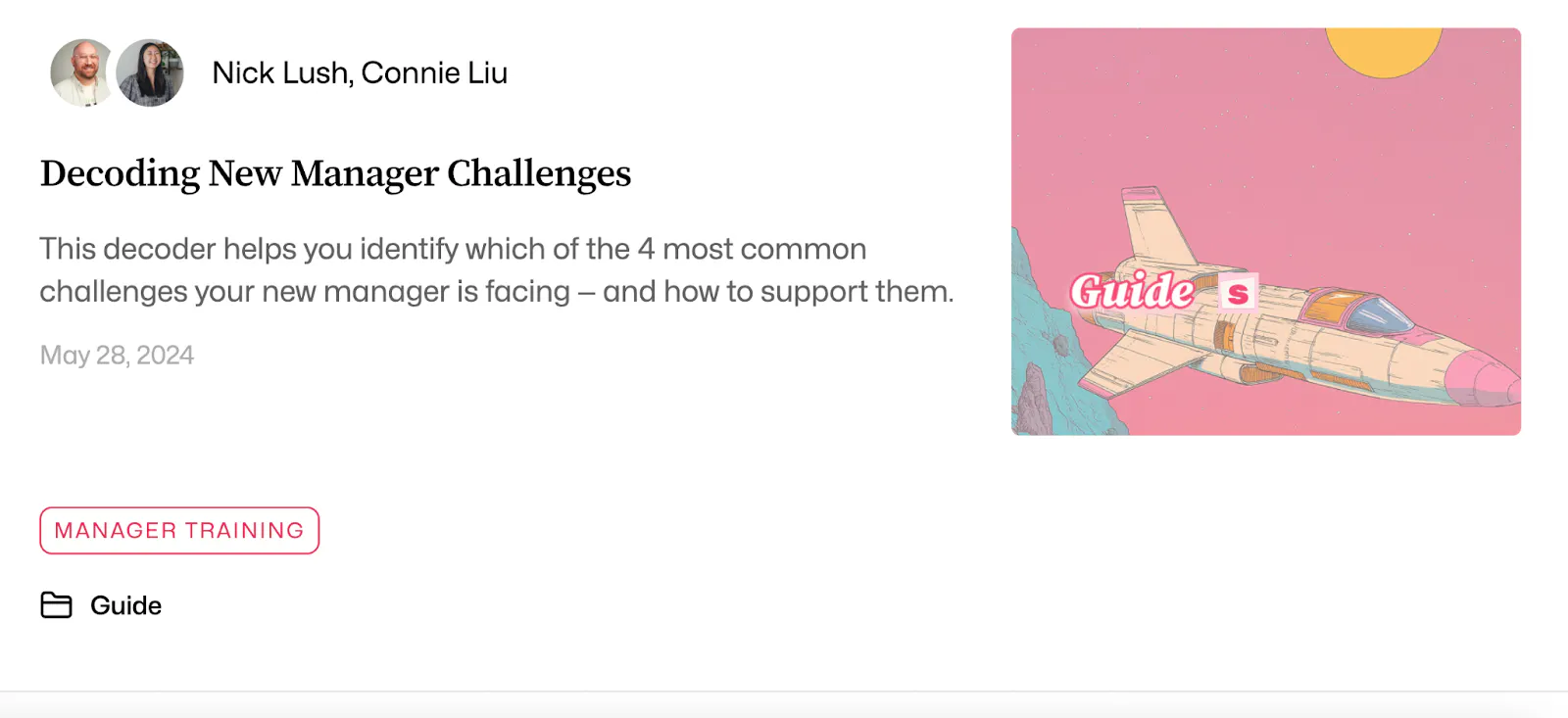
This week’s resource is a guide written by Connie Liu and Nick Lush for those looking to support their new managers. Use this guide to determine which of the most common challenges your new manager is facing and learn how to help them. Check it out HERE ⬇️
FRIDAY FUN
🫶🏽 Knowing AHEAD of time is nice... Copy anchor linkCopied
.png)
One of my least favorite things is hearing about something AFTER the fact!!!!
Just. Communicate. Please.
It's not that I don't love surprises, I just don't love constantly having to clean up messes that had HR been looped into at the start it wouldn't be a MESS.
BTW: I'm def Team Conrad <3
That's all for this week! I hope you enjoyed! If you have any thoughts, please let me know. I'm allll ears.
Reminder: Today is FRIDAY. 🙏