overwhelmed & oversharing
Hi ya party people,
What a wild 24 hours the internet has had. It was just one of those days that EVERYONE was talking about the same thing.
Coldplay's best song, obvi. JK JK
By now if you haven't seen the video circulating of the CEO / CPO at the concert you may want to just Google Coldplay concert.
It's bringing up a lot of commentary about behavior at work, power dynamics, and naturally HR. I'm seeing a lot of takes about how this is why you don't trust HR and it's REALLY bothering me.
There's so many layers to this situation, many we don't know. But I stand firm in my stance that CEO's have a lot of power, there should be consequences for their bad behavior and relationships at work with a power imbalance are NOT OKAY.
What's your take? Happy to listen.
But first today's Q&A:
On one hand, supervisors are trying to keep teams afloat without assigning “emotional breakdown” as a deliverable. And on the other hand, someone on the leadership team is using your meetings as a live audio journal.
So roll up your sleeves and let’s dig in!
And don’t forget to send me all the unhinged questions you have for a chance to be featured! 😇
ASK AWAY
😩 workloads & whinersCopy anchor linkCopied

✍🏽 What are some ideas for supervisors to manage workload?
Context: The vast majority of workers feel overworked and are overwhelmed by their workload. What are some ideas that supervisors could implement to manage workload?
📣 Lia Seth, Director of People @ Cylinder Health:
Sounds like a great time to implement the Eisenhower Matrix! Between shiny new object syndrome and the fire alarm of the day, there's so much noise in the working world today. This time management tool helps folks prioritize their workload into what is the most urgent vs the most important. If something is urgent AND important, that task should be first. If the task is neither, it can be put off. Urgent, but not important? Delegate to your team.
The key part of this tool, though, is defining what "important" means, since it's such a nebulous term. If your organization doesn't have OKRs or annual goals, this can be much harder, so those should be defined first. What does success look like for your company, and your team? Are you trying to hit a certain revenue by the end of the year, sell a specific number of units, speak at a certain number of conferences to get your name out there, reduce your client response time from one week to 48 hours? Once you have those decided and agreed on by senior leadership, your decisions will start to make themselves. If it gets you closer to the goal, that's what to focus on. Everything else is noise.
📣 Kailey Cartwright, Head of Learning & Development @ SurveyMonkey:
In addition to the great suggestions below, I really like to think about "big rocks." It's a really simple way to uncover where someone is spending their time. The simple version of the sort of story here is that if you are identifying your "big rocks" and working on / prioritizing those "big rocks" above the smaller rocks (i.e. admin tasks) or sand (i.e. email) in your day-to-day, you are prioritizing what matters. I ask my team to identify their "big rocks" every month. Those "big rocks" should connect to our quarterly goals and annual goals. Then, we can talk through what is the *most* important thing for them to prioritize or where we need to make trade-offs when other priorities pop up. I also encourage my team to schedule in admin / email time at the beginning / end of the day (and turn off notifications!) so that they aren't getting pulled into things that can honestly wait (we're in L&D - there aren't emergencies in L&D!).
I've found "big rocks" to be simple, effective and help me and my team understand where and how we're prioritizing our time to be effective, efficient and hit our goals.
📣 Sondra Norris, OD/OE Consulting:
Many things could be going on in this situation, so the first question is: ARE THEY REALLY BEING ASKED TO DO TOO MUCH? For real, there is not enough time in any day for anyone to get the work done.
Two general approaches:
- Mager and Pipe's model has us ask the question, "What parts of this problem are a systems issue and which are a skills issue?" This would lead you down the path of identifying processes and systems that are slowing things down. An observational analysis would reveal where people aren't skilled up enough – perhaps requiring help from others instead of being able to work independently.
- Supervisors should use something like Lia suggested so that even if employees are genuinely overtasked, their performance rating isn't at risk because they've successfully completed at least Important/Urgent tasks; and Important tasks are underway. Supervisors should be capable of providing the playing field:
- our team is responsible for accomplishing A, B, C goals in the next XX time period
- here are the tasks, in order, that will get us there
- here are the tasks, that are important, but come second.
Would be recommended for the employees to make suggestions beyond ‘give us less’ or ‘hire more people’ – AFTER they understand the priorities of the department and why they are priorities.
Either way, if management doesn't address it – the employees' belief that management doesn't care will grow and erode trust.
Safe Space members can join this discussion here. Not a member yet? Apply to join here.

✍🏽 An employee on our leadership team continues to hijack our status meetings with complaints about her work/life balance, how other people in the company offend her and her social/emotional grievances. She recently stated that "this is her slowing down season" at a meeting. She never works more than 40 hours a week and is a salaried employee with a flexible schedule and we've tried to help her find more balance with creative solutions. She's never happy. While we want to make space for her concerns, we are growing weary of the conversation. How can we set some new boundaries to help us move forward?
Context: Our growing company provides cooking classes, camps and parties for kids and their families in schools, community events and at our two locations. We have 50 employees and our general managers (3) handle all of our HR as a team.
📣 Inas Laghzaoui, Head of HR & CSAT @ CE Brands International:
It sounds like some of her frustration might come from feeling disconnected or unheard. I’d suggest setting a clear agenda for meetings and gently sticking to it, but also having a kind, private conversation with her. Acknowledge her concerns, reassure her that she’s valued, and explore whether she’s feeling out of place or unsupported, but also explain that leadership meetings need to stay focused so the whole team can be effective.
That way, you’re setting healthy boundaries while showing genuine care. Sometimes people just need to feel seen, safe, and appreciated in their role. Since she mentioned it’s her ‘slowing down season,’ it could be that she feels she’s been giving a lot without feeling recognized.
📣 Olivia Maurer, HR Generalist @ Justice Law Corporation:
It sounds like you're in a tough spot – especially in a growing company where leadership time and focus are crucial. We can work towards setting clearer boundaries around the purpose of the meetings. You might consider resetting expectations with the team by explicitly stating that leadership or status meetings are for operational updates, team alignment, and strategic problem-solving – personal grievances can be handled/discussed via other avenues. That framing keeps it about the function of the meeting, not the individual. Providing an agenda for the meeting will support this idea as well.
To still support your employee, you could offer a separate channel for more personal conversations – like a monthly wellness check-in, dedicated 1:1s, or even an anonymous feedback form. That way, you’re creating space for those concerns without letting them dominate group time. In the moment, give yourself and your fellow GMs permission to respectfully redirect: “Thanks for sharing that – let’s take it offline so we can stay on track with the agenda” It helps reinforce the shift as a team-wide norm too!
📣 Alexandra E., CHRO @ Credit Union:
This is someone on the leadership team? If a senior team member is publicly struggling to manage a 40-hour, **flexible** schedule and regularly venting about work/life balance in front of both leadership and the broader team, well… uh. Yeah. Nah. That’s a definite no.
It’s fair to ask: If the people at the top seem overwhelmed and dissatisfied, how is everyone else in the company supposed to feel? The team is watching – always. Leadership sets the cultural and emotional tone, whether they mean to or not.
And when a leader turns status meetings into group therapy – minus the confidentiality or the healing – it derails the conversation and destroys morale. That’s a big ol Yikes.
Has anyone had a direct conversation with her about this? Not from a “how are you feeling today?” HR position,
sorry, not sorry because we’re kind of past that –
but from the standpoint of leadership optics and cultural impact, because it sounds like that conversation is overdue?
To be clear: her feelings are valid. We all hit rough patches. Everyone has a “burn the to-do list” day or maybe two…or possibly 5...😬 👀
But if she’s on day 458 of “set it all on fire” then it’s too much and she’s gotta stop.
If the folks who are supposed to have the most control, flexibility, and influence are visibly unhappy – and annoyingly vocal about it – it undermines the morale & structure. Worse, it makes others start questioning whether they should feel miserable too. That kind of ripple effect is (I hate this word, but…) toxic to a fast-growing business.
Realistically, she may very well have one foot out the door – all that complaining rarely means folks are in it for the long haul – but in the process of heading out the door, she’s unintentionally holding it open for others to join her with all that negativity.
So I’d start there: an honest, empathetic conversation with her, focused on leadership responsibility and the impact of all of these comments. Chances are, she doesn’t even realize how her words are hitting the team.
And not to sound like a corporate curmudgeon, (ok maybe a little) but… if you want the title, you gotta wear the shoes.
Leadership means being held to a higher standard – and knowing that your mood, your comments, and your “slowing down season” monologues don’t just belong to her when she announces them in a public forum because they set the tone for everyone else.
(and again, I’m sorry, but her…WHAT…season?!?! What The Actual Fudge is she thinking, saying those words in a team setting.) 😳🤯😑
::hops off my soap box::
Safe Space members can join this discussion here. Not a member yet? Apply to join here.
🚨 ON YOUR RADAR
🎧 I Hate It Here Podcast: A brand new season with more of your favorite People Ops leaders is coming SOON! Check it out on Spotify or Apple Podcasts!
📺 HR Therapy: Welcome to the Sh*tshow! A real look at the horrors of onboarding and what we can all do better!
📺 Safe Spacers Kailey, Ciara, and I are teaming up for a panel on the role of AI in employee development and how to navigate this new era we're in. Grab a spot and get all the tips you need!
🫶 Stephanie Lemek, Founder & CEO at The Wounded Workforce, is rolling out two new certifications in August: The Trauma Informed Workplace Leader and Trauma Informed Workplace Executive. Learn more here!
🤖 Hiring isn’t slow because you’re bad at your job. It’s slow because you’re stuck in systems that refuse to evolve! Gem understands your pain, so they pulled together 8 real ways recruiting teams are actually using AI (like, right now) to hire faster, smarter, and without the chaos!
📝 RESOURCE OF THE WEEK
Each week I feature a resource I love from the Safe Space library that I believe would be relatable to this week's newsletter topic.
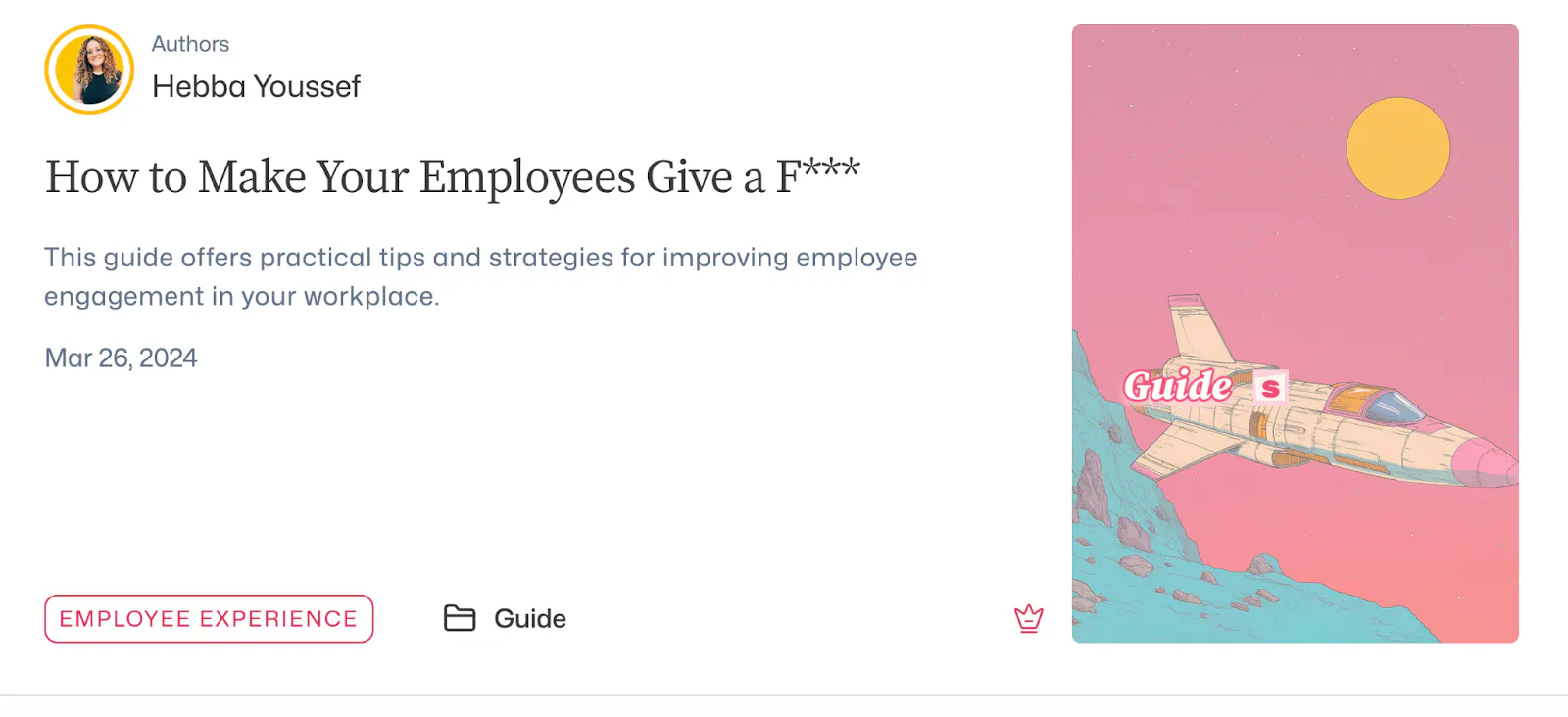
This week’s resource is a guide I created to help you improve employee engagement in your workplace. If you’re looking for strategies to get your team genuinely invested in their work, check it out HERE ⬇️
FRIDAY FUN
😩 Everyone's got something to sayCopy anchor linkCopied
.png)
It's been a wild 24 hours to say the least.
That's all for this week! I hope you enjoyed! If you have any thoughts, please let me know. I'm allll ears.
Reminder: Today is FRIDAY. 🙏