PTO queen vs old job king
Hi ya,
Happy Friday, fellow Chaos Wranglers! 🤠
It’s our last Friday newsletter before spooky season is here!
I’m just giving you a fair warning now, in case I get carried away with inescapable Halloween puns. The temptation is strong.
Sooo now that you’ve accepted the terms and conditions of my pending corny jokes, we can move on to Q&A!
First up: the employee who treats every week like a new PTO challenge—vacation, sick day, floating remote day…she’s not technically breaking rules, but she sure is breaking patience.
Then we’ve got a manager who can’t stop prefacing every decision with, “Well, at my old job…” Cool story bro, but you don’t work there anymore.
Two questions, two headaches, and zero margaritas (yet).
Let’s dig in before we all request a floating day of our own.
And don’t forget to send me all the unhinged questions you have for a chance to be featured!
ASK AWAY
😑 ego & PTOCopy anchor linkCopied

✍🏽 We have an employee who requests sick leave, vacation time, or a floating remote day (we allot 10 per calendar year, in addition to our 3/2 in-office/WFH schedule) almost every week but hasn't exceeded what's allowable. What can we and can't we say to the employee?
Context: Located in Massachusetts. Large organization with central HR, but central HR isn't wanting to get crystal clear about what we can and cannot say. The employee's performance isn't great but is somewhat improving with coaching and direct communication. This frequent level of disruption means she's not getting her work done on time or done well.
📣 Bethann DuBois, HR Manager @ Nipro PharmaPackaging Americas:
If she is not exceeding what's allowable, there isn't a whole lot that can be said. If this was my employee, I would try to just have a regular conversation with them, and ask them if everything is ok at home and/or at work, as I noticed they have been requesting more time off than usual.
In my experience, at least half the time there IS something going on that qualifies for either FMLA and/or state protected leave. But even if they don't share anything like that, you at least went one step further to try to find out what's going on. They will also know that you have noticed the increase in frequency of time off requests.
📣 Bri Harrison, Sr. Manager HRBP @ Afresh Technologies:
I agree with Bethann — if the employee isn’t exceeding the allowable time, it’s less about “can they take it” and more about “what’s the impact on performance.” I’d frame it as:
- A check-in: acknowledging you’ve noticed the increase in time-off requests and asking if there’s anything they want to share.
- Performance clarity: separating the leave from the work expectations — make clear that deadlines and quality expectations remain, regardless of how much time they take.
- Reliability impact: call out how the frequency is affecting workflow or coverage, and partner with them on a plan to improve consistency.
- Support angle: keeping the door open in case there’s something protected (FMLA/ADA) in play.
That way, you’re respecting the policy and but still holding the line on performance expectations and team impact.
📣 Maleea Meden, HR Director at World Centric:
This is a tough one. I think the best course of action is to continue with the coaching and direct communication. Focus on the performance above all else.
Ideally, through the continued coaching and direct communication the employee begins to conclude that taking a lot of time off may not be in their best interest for maintaining performance. The challenge you have is that if you have a culture where planned time off doesn't have to be pre-approved, then you can't hold it against them when they take it.
This is especially true if they're taking time for sick leave or caregiving responsibilities. If they're taking time by choice, then it's worth pointing out that it may be interfering with their ability to get up to the level of expectations.
Focusing on performance and expectations is key, and ensuring they're consistent among peers, and there isn't a subtle bias because they're using a benefit that others may not use to the same extent.
Safe Space members can join this discussion here. Not a member yet? Apply to join here.

✍🏽 What is the best way to handle a new manager whose response to most things is "Well I didn't do that where I used to work"? HR is allowing this to go on and this new manager tells the subordinates the same excuse.
Context: 50 people/international firm/finance
📣 Rosetta Williams, Sr. Director, People Talent & Culture @ Immigrant Justice Corps:
When a new manager frequently says, “Well, I didn’t do that where I used to work,” it’s often a sign of cultural misalignment or difficulty adapting to a new organizational environment. In an international firm—especially in finance—this can quickly erode team cohesion and credibility.
Why It’s Problematic:
- Signals resistance to change.
- Undermines current practices and norms.
- Can confuse or demoralize teams.
- Creates a divide between leadership and staff.
HR Strategies to Address It:
- Leadership Onboarding: Ensure new managers receive cultural orientation—not just operational training.
- Peer Mentoring: Pair them with a seasoned leader who models the firm’s values and communication style.
- Feedback Mechanisms: Use 360 reviews or pulse surveys to surface concerns constructively.
- Coaching Conversations: Encourage framing ideas as contributions, not comparisons. E.g., “Here’s something that worked well before—how might it fit here?”
- Protecting Culture: Reinforce organizational values in team communications and leadership forums.
Bottom Line: HR must help leaders transition, not just transfer. The goal is to integrate their experience without alienating the existing culture.
📣 Sandi Creyaufmiller, SVP Culture & Talent @ Marine Bank
This is a failure of upline management and HR for not properly introducing the new manager to "How we do things around here." What are the organization's values? How are they incorporated into the business?
This new manager was brought in because of their experience, so you need to balance the experience with how it can add value here. Perhaps a mentor would be helpful to aid this new manager in their role.
If the new manager is reluctant to accept a mentor, let them know this is how we can set them up for success.
📣 Sondra Norris, OD/OE Consulting
A new manager needs all sorts of orientation to how they will be successful at a new company, and a great conversation can be had.
1. SET THE STAGE. Our values, why they're important and how we use them to build and reinforce trust in all our leaders - specifically what we ask managers to do. In general through the course of getting normal work done, managers should be referring to our values and making examples of how we protect them, how we actively prevent violations of them, and how we balance them.
For example "Delight our customers" can often conflict with "Our employees come first" when customer care constantly requires hero behavior, listening to the loudest voice, failing to attend to core operating problems. This can be a very rich conversation by asking the manager how this worked and didn't work at their last place - and encouraging to them because here they'll be able and expected to do this.
2. COMPARE AND CONTRAST. What lessons, good and bad, has the new manager learned in their lifetime of being in a position of influence and leadership? Orient the manager: they may be carrying "good lessons" that actually won't work here.
3. SET UP FOR SUCCESS. "Here's what being a great manager looks like here." Highlight the most important manager competencies - for what we're trying to achieve in the business. Sometimes it's more collaboration than individual expertise - sometimes it's the reverse.
Sometimes it's more develop a junior team than it is let your team of senior, experienced people do their thing. Another great conversation comes from this to set up 30-60-90 day goals around metrics and learning and actions.
Specific to this situation, this isn't HR's responsibility - it's the new manager's manager's responsibility to help this person be successful in their new role. A very direct response to this person when they say, "We didn't do it that way at my last company" is to get curious AND to inform. "Here's why we do it this way here ..." and "How did you do it that was different? What were the business circumstances that led to that approach?" and "What was required for success?" and "What were the results?" and "How could you see that working here?"
Safe Space members can join this discussion here. Not a member yet? Apply to join here.
🚨 ON YOUR RADAR
🎧 Sometimes the policy binder says one thing, but real life says… yeah, that’s not gonna work. I sat down with Stephanie Schuler to dig into the messy, gray moments you can’t Google, where fairness, consistency, and actual human judgment collide. Check it out on Spotify or Apple Podcasts!
✅ Is your total rewards strategy working, or just checking boxes? Aon shows how data, alignment, and clear communication can turn rewards into a real driver of retention and well-being. With 60% of employees eyeing the exit door, it's worth a read!
⏰ Regular rate pricing for the Safe Space Summit ends Oct. 2! The agenda is set: We'll be doing sessions on burnout, leading through chaos, fixing performance, AI, trust, and yes…the CEO<>HR drama we all know too well. Grab your pass here!
♥️ From ‘I Hate it Here’ to ‘I Love it Here’: Your Culture Transformation Roadmap. HR can influence culture change in any organization, and this course teaches you how. Join the Safe Space community to access it!
📝 RESOURCE OF THE WEEK
Each week I feature a resource I love from the Safe Space library that I believe would be relatable to this week's newsletter topic.
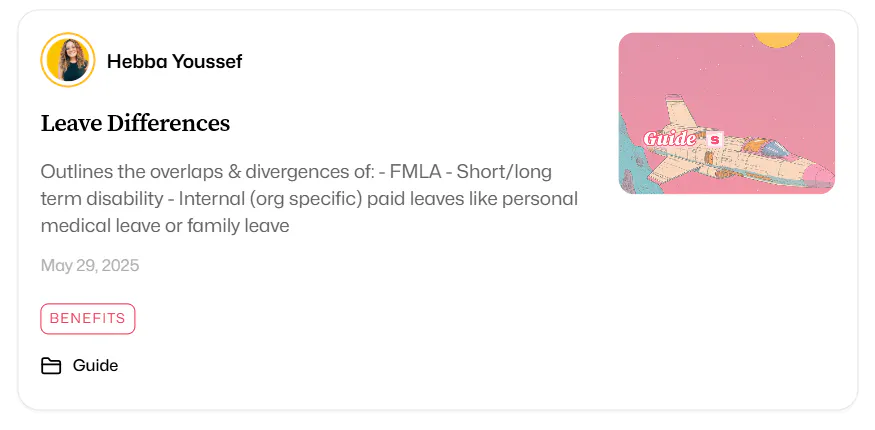
Today, we’re looking at leave differences! Check it out HERE ⬇️
FRIDAY FUN
⏰ it's that time againCopy anchor linkCopied
_iv0y.png)
SOME WEEKS IT REALLY DO BE LIKE THIS!!!!
I usually need to take a walk or do something to get this feeling out of my system.
That's all for this week! I hope you enjoyed! If you have any thoughts, please let me know. I'm allll ears.
Reminder: Today is FRIDAY. 🙏