this leadership is cooked
SUPPORTING PEOPLE WITH

Hi ya party people,
Just recently got back from Workhuman’s conference and all I can say is wow, I’m FULL. ✨
Full of nuggets and genuine hope for what HR can be when the right people are in the room together!
(The knowledge kind, not the chicken kind, although Orlando had both.)
Unfortunately, not every room has the right people in it, and our Q&A is a weekly reminder of that. 😬
This week, we've got two questions that are different flavors of the same nightmare.
First up: a non-profit HR leader who's being handed a mop and told to clean up a flood that leadership keeps causing, on purpose, repeatedly, with zero accountability and maximum audacity.
And second: someone working in an org with no HR whatsoever, where two-plus years of microbullying and passive-aggressive chaos have just been left to marinate like nobody's problem.
Let’s talk about it!
Also, submit questions if you have any!
SPONSORED BY SIXFIFTY
Letting someone go can be so complicated sometimes. 💔
It's basically a compliance minefield dealing with stuff like final pay timing, PTO payouts, separation agreements, state-specific rules that change everything...I could go on and on!
SixFifty's free webinar, Separation Compliance: Best Practices for Notices, Final Pay, and Agreements, is for HR teams who'd rather NOT find out what they got wrong via a lawsuit. 😬
On May 7th, they're covering the full separation playbook!
You'll learn about terminations, voluntary departures, waivers, non-competes, sick leave, and the state-by-state chaos that makes it all worse.
So if you're just winging your process right now, this will give you the system you need!
ASK AWAY
💡resources & accountabilityCopy anchor linkCopied
✍🏽 How do you navigate leadership that has a bad approach and refuses accountability but blames the staff for being immature and/entitled. The want HR to fix a culture that they are constantly breaking.
Context: Non-Profit with private and public funding that is tied to metrics driven results that impact real life clients, slightly under 100 staff members, toxic often retaliatory and biased behaviors from leadership.
📣 Sondra Norris, Founder @ Strategic Culture Partners:
This is a HUGE question. And it starts with understanding the Human OS, particularly it's protective and defensive mechanisms, the source of "bad behavior," including calling the staff immature/entitled. After the Human OS in general, comes the Human OS in organizations: constructs defined by hierarchy and running on politics, power, and perception... and how leadership created the environment within which those are flourishing. That's no easy task and you can't take it head on. We know it's about trust and commitment and leadership and at least 15 different validated psychological theories ... you just can't enter that way.
FIRST.
Define it as an organizational performance problem: goals and strategies are not progressing as they should and we need to understand the causes of that. We need data to meet the leaders where they are. They won't be receptive to a "leadership" or "culture" message. Because in their minds they've individually and collectively decided where the blame lies. Collect data from the first top 2-3 levels of leadership/management to determine where the trust fractures and execution gaps are. This isn't an engagement survey. This is a strategic culture analysis and diagnosis. There are four places that leadership typically breaks or builds trust: Predictability, Leadership Credibility, Culture Alignment, and Relational Security. What happens in those four areas determine how much Discretionary Commitment is earned (and deserved) from the staff. Additive to this case is knowing how staff view the Operating Conditions they are working in.
SECOND.
Prepare the top 2-3 levels of leadership/management. Take the results about them to them BEFORE opening anything up with the staff at large (this sets an expectation that an undoubtedly incapable leadership team can't deliver on ... increasing the size of the fracture). This is a big reset. Laundry needs to be aired. The Executive Layer needs to "come to Jesus" and start doing things differently - they need constant help and support to notice WHERE they need to do things differently so they don't act from muscle memory. All the top levels need to galvanize around their individual and collective leadership intentions - which are still there, but have been probably long packed-away and covered over by their Human OS protective mechanisms.
THIRD.
Leadership kicks off to the company at large their refreshed approach, now willing and able to talk about how they allowed their leadership intentions to slip and staff (and the business) has been paying the price. They share what they really stand for and against. They share how this happened and that they are taking accountability.
FOURTH.
Survey the company at large with the same survey the leadership level's completed. Conduct focus groups to understand (1) what would truly make the difference to the staff and (2) the cultural legends that have become the staff's "here's how it is around here" belief system. Now leaders will understand the true depth and length of the belief system (what they're up against even if they didn't create it), and respond quickly and appropriately.
FIFTH.
The change/transformation cadence. One of the core dynamics of the Human OS that leads to detachment in any relationship is real or perceived broken promises and trust. And the only thing that may fix that is establishing a new pattern - for how long depends on how big the fracture is, how old the stories are. But the fix is simple. Promise to fix one thing that is truly important to the company. Fix it. Tell the company the first one is fixed. Rinse and repeat on a 30-45 day cadence. Give the staff proof points. Be relentless. Connect these action to the individual and collective leadership intentions (that list doesn't vary much from person to person or from company to company). Prioritize this over everything else.
This isn't leadership training. This is a deep HR-supported internal consulting gig. It's doing the development IN the work with them. It's incredibly meaningful work. It improves conditions for every staff member and every person depending on the staff member for financial health, as parents, as partners, as community members.
📣 Karen Wood, Human Resource Department Manager @ United Consulting:
I once saw a video about leadership and looking into the mirror first before passing judgement. Self-reflection and self-awareness are key to understanding the impact around you. If you and someone else (I would have another trusted colleague in the room with you) can bring this to their attention, carefully and with empathy, I would recommend that. Give a concrete example, like "when you yell at this individual in front of others for making a mistake, it leads to a negative impact of employees who cover up their mistakes or blame others, eroding our Company Value of Trust." They may not even be aware of their impact on others. Because of the power dynamic, I would ask the leadership team if they are open to having a candid conversation about their leadership impact and how it relates to the culture they are wanting to be improved. If they are not open or continue to ignore the leadership mirror, I would suggest looking elsewhere for a better work environment. Good luck!
📣 Tammi Burnett, Director of People and Culture @ Rainforest Action Network:
I think others have given great answers, but I'll be very direct in my opinion: you don't. Or at least, I wouldn't. I would be exploring other opportunities, and would move on. I love solving problems, but I refuse to be a savior or a martyr for a leadership team like this.
Safe Space members can join this discussion here. Not a member yet? Apply to join here.
✍🏽 What are the best resources for orgs without HR?
Context: Our organization does not have HR, leaving regular old classism and intensified microbullying, passive-aggressive behavior, and harm to productivity unresolved for over 2 years now. Is there any hope for orgs that won't add HR?
📣 Alex White, Regional Director, HR @ Washington Duke Inn & Golf Club:
This one’s tough - and I’ll be honest, lack of HR isn’t really the root issue here.
You can operate without a formal HR department, but you can’t operate without accountability.
If they won’t bring in HR, there are still a few levers:
Bring in a fractional HR consultant or external advisor
Put basic policies in place (code of conduct, reporting channels)
Invest in some level of leadership training
Document everything - patterns matter
Organizations don’t need HR to care about their people - but they do need someone willing to step up and own the environment they’re creating. If that’s not happening, progress will be limited no matter what tools you bring in.
Here’s the real talk…if classism, microbullying, and passive-aggressive behavior have been ignored for two years, that’s a leadership choice - not a resource issue.
So yes...there’s hope. But only if someone at the top is willing to take accountability and do something different.
If not, you’re trying to fix a system that doesn’t actually want to be fixed.
📣 Jessica Simmons, VP, HRB @ PICD:
There's hope, but only if someone addresses the real issue. Culture is shaped from the top down. When issues linger for years, it signals what leadership is tolerating. Even if you brought in HR, progress would stall unless the CEO and senior leaders are willing to acknowledge the problem, model better behavior, and consistently reinforce expectations. HR can support structure and accountability, but it can't override leadership signals.
In the absence of HR, someone needs to raise this directly with the CEO. The issue would need to be tied to business impact such as, productivity loss, team friction, and retention risk. If the CEO and leadership are open, you can introduce simple guardrails like clear behavior expectations and escalation paths. If they're not open, the culture is unlikely to change in a meaningful way and will continue to function as it has been allowed to.
📣 Mandy Kutschied, HR Consultant @ Cup of Culture Consulting, LLC:
💯 to what @Alex White stated! This isn't fundamentally an "HR or no HR" issue, it's an accountability and leadership issue. Honestly, I’ve seen organizations with full HR teams still struggle with exactly what you’re describing so bringing in HR alone won’t fix it, but the right kind of support can absolutely help.
I'm a little bias working as an HR Consultant, but I do think a strong option is a fractional HR person or firm. For organizations that won’t (or can’t) hire a full-time HR leader, this can be a really practical middle ground.
It brings in:
-Objective perspective (which matters a lot in environments with entrenched dynamics)
-Clear systems — code of conduct, reporting pathways, manager expectations
-Leadership coaching + accountability structures tied to business outcomes
But even then, it only works if leadership is willing to engage and be part of the change. *You can’t outsource culture repair!!* And I know I'm preaching to the choir here, but culture isn’t a vibe it’s an operating system.
It’s the combination of:
- Beliefs (what you say you value)
- Behaviors (what’s modeled, rewarded, ignored, or tolerated)
- Systems (how decisions get made, how feedback is handled, what happens when something goes wrong)
When classism, microbullying, or passive-aggressive behavior go unaddressed for years, that is the culture.
Which also means… it’s fixable, but not quickly or passively. And like others have said, that only works if leadership is willing to engage and be part of that change. So yes, there’s hope. But it’s less about “adding HR” and more about whether the organization is actually ready to operate differently.
Safe Space members can join this discussion here. Not a member yet? Apply to join here.
🚨 ON YOUR RADAR
🎧 You know that moment when you realize your whole identity got wrapped up in a job that was never really working? I sat down with Lauren Schneider to talk about how you start reclaiming the parts of yourself that work convinced you didn't matter. Check it out on Spotify or Apple Podcasts!
⭐ Four days in Huntington Beach, 200 senior HR leaders, zero cost to attend, and absolutely zero fluorescent lighting or stale bagels. Safe Space Summit is the event I wish existed when I was losing my mind in back-to-back exec meetings. It's application-based and Director-level and above only, so if that's you, go apply and find out if you're in!
📖 Still giving out generic “great job” shoutouts and expecting engagement? Recognize has a free ebook that shows how modern teams are using tech and data to make recognition feel genuine (and not painfully corporate).*
💰 Pay Transparency matters (but it's also difficult). That's why I created this course. Join the Safe Space community to access it, plus everything else you need to stay ahead of the curve.
*This one is brought to you by one of my amazing brand partners
📝 RESOURCE OF THE WEEK
Each week I feature a resource I love from the Safe Space library that I believe would be relatable to this week's newsletter topic.
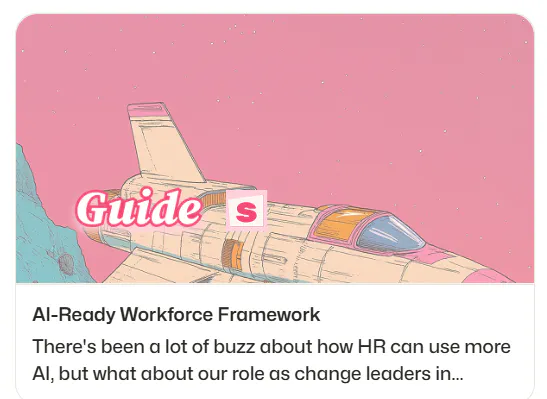
This week, we’re revisiting an AI-ready workforce framework. Check it out HERE ⬇️
FRIDAY FUN
😳 hey ummm is everything okay??Copy anchor linkCopied
_f9d9.png)
WE'VE ALL BEEN THERE
AND if you haven't, you're lucky.
People do be getting heated and sometimes we have to intervene.
That's all for this week! I hope you enjoyed! If you have any thoughts, please let me know. I'm allll ears.
Reminder: Today is FRIDAY.