
I regret to inform everyone that we’re going to keep talking about AI for a little while longer!
I know, I KNOW, some of you are already tired of hearing about it.
Trust me, I’m also tired of hearing about it, and I literally host convos about it regularly! 🤪
- Every conference has an AI panel
- Every company has some kind of AI task force
- Every exec has recently returned from a dinner where another exec said something about AI agents, so now your entire Tuesday is ruined
“Can we talk about something else, Hebba???”
Yes, but unfort not today. ❤️
AI will be part of the workplace convo for the foreseeable future, regardless of whether you’re excited about it, deeply suspicious of it, or one LinkedIn slop post away from throwing your laptop into traffic.
We’ve crossed the threshold, folks. The genie has left the bottle, and yet…something strange is happening that we deff need to talk about.
A lot of orgs feel much further along with AI than they really are. 👀
What I mean is, they bought the tools and made a company-wide announcement. Maybe the CEO used ChatGPT twice and now keeps saying things like, “Couldn’t we automate that?” during meetings.
The confidence is stunning, but the competence is a whole other story!
We’re overestimating our confidence compared to our actual ability, and HiBob’s research among 1,200 AI decision-makers backs that up.
68% of orgs say they have a defined strategy for sourcing AI skills, but only 24% are taking concrete steps, such as tagging those skills in their ATS.
Soooo, where is the strategy????
Is it in a deck? Is it on a whiteboard? Did someone write hire AI talent on a Post-it and slap it on the wall? Come on now! 😭
The numbers themselves sound impressive, until you poke them a little and the whole thing starts making a noise.
If everyone says they’re investing in AI, why is so little of the training consistent? 🤔
If AI skills influence promotions and performance ratings, why can’t anyone agree on what those skills are?
And if people are already sick of hearing about AI, what does that say about their company’s AI maturity?
My theory now is that maybe the exhaustion isn’t coming from too much progress, but too much theater, and that’s a much more interesting convo to have.
So, let’s get underneath all of it and talk about the operating model required to make AI useful, plus three behaviors that will tell you whether your company is maturing: how you source early talent, how you develop your people, and whether you’re doing any of this fairly.
Because we are gearing up to have a hellish 2027 if we keep evaluating AI maturity based on who talks about it the loudest!
Your Operating Model Needs to Exist Outside a PowerPoint

Maybe in another life I was a COO, because I’m always thinking about operating models!
Who owns this? Where does the work go next? Why does this approval take nine days? Why are four departments involved? Why is Gary the only person with access to the spreadsheet?
…And why is Gary always on vacation?
This is the part of AI adoption that sometimes gets skipped because buying tech feels way more exciting than mapping how work actually happens.
Before you decide where AI belongs, you need to know how value moves through the business.
So that means even more questions!
For example:
Which steps require judgment?
Where does work sit around waiting?
Who reviews it?
What happens when something goes wrong?
Which mistakes are annoying, and which ones are straight-up legal landmines?
AI can turn a day-long task into five minutes, which is amazing and I truly love that for us, but if the result still sits in a week-long review process, what did you even fix?
This is why AI maturity has to be treated as an operating-model question.
The tool is one piece of a MUCH larger, messier system involving workflows with accountability, and humans who will absolutely create a workaround if the official process irritates them enough!
HiBob’s research found that some of the most valuable AI behaviors are reviewing output quality and documenting decisions.
After years of making AI sound like digital sorcery, the behaviors that create value are basically diligence and good notes. Honestly, I find that kinda comforting.
Yes, AI can generate something quickly, but somebody still needs enough knowledge to notice when it has produced beautifully formatted BS.
That brings us to the first behavior! 🤓
#1: Source Your Early Talent Without Destroying the Talent Pipeline
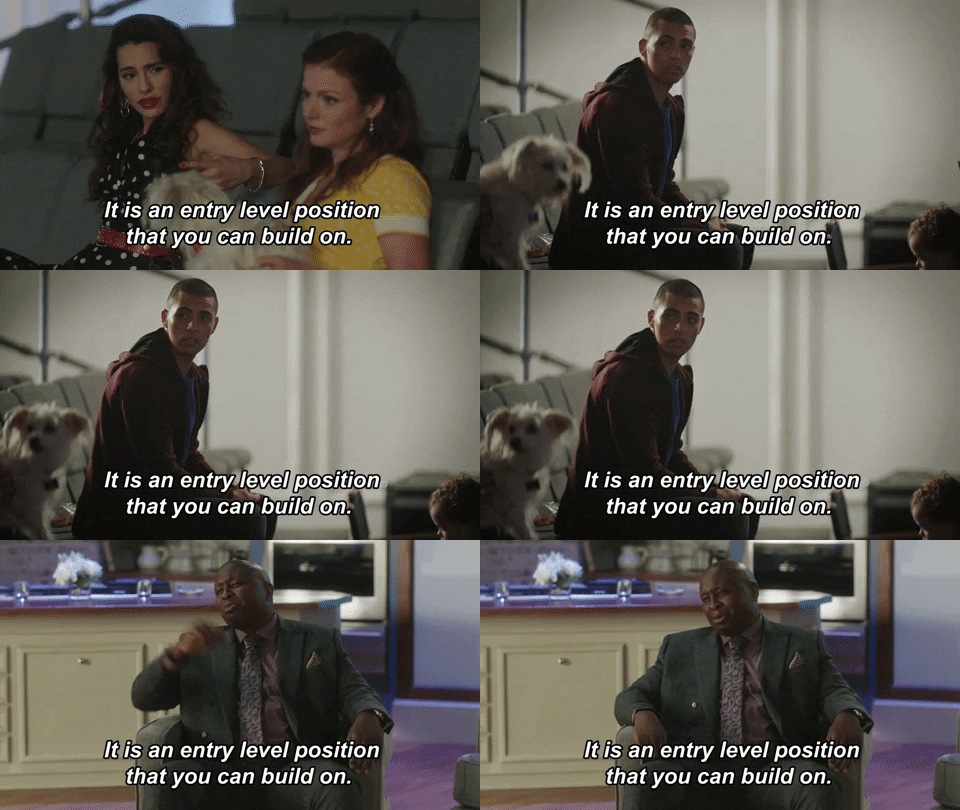
📢 Entry-level workers are about to get absolutely body-slammed by this transition if companies aren’t thoughtful!
A lot of the tasks that orgs want to automate are the EXACT SAME tasks early-career employees used to learn the business.
That includes things like basic research, sorting information, pulling reports, or doing a task badly once, then getting feedback and slowly developing judgment.
The work is rarely thrilling, so I understand some of the rationale. Nobody has ever whispered, “God, I miss manually cleaning spreadsheets,” while staring wistfully out a rainy window.
But for what it’s worth, those tasks taught people things!
They showed employees how the pieces connected, then they could ask embarrassing questions and understand why a process existed before they were expected to improve it.
If AI handles all the beginner work, how does anyone stop being a beginner???
Orgs obviously can’t respond by hiring only experienced people forever. Eventually, you run out of people who were somehow born with 8 years of experience. 😒
This means your sourcing strategy has to be more specific than looking for AI literacy, which has become a phrase that currently carries like 900 different meanings:
- What behavior are you hiring for?
- Can the candidate evaluate an AI-generated answer?
- Will they check a source?
- Can they explain how they reached a conclusion?
- Do they know when they’re outside their depth?
- Are they curious enough to ask why an output looks weird instead of copying it directly into a document and hoping nobody notices?
Trust me, I could go on and on, but those are good examples of observable behaviors.
You can build interview questions around them, then create assessments. You can also tag them in your ATS and explain them to your hiring managers!
Only 24% of companies in HiBob’s research use concrete sourcing mechanisms like ATS tagging for AI skills, even though 68% claim to have a sourcing strategy.
👀 That gap should tell you plenty.
We’ve gotten very comfortable describing intentions as strategies, then someone asks what the strategy contains, and suddenly everyone needs to jump to another call.
Your early-talent strategy should also answer a harder question: what will these people get to learn?
If you remove the foundational work, it only makes sense that you need another way to build foundational judgment.
That might mean simulations, deeper coaching, or assignments where employees review AI output against expert work.
Otherwise, today’s efficiency gain becomes tomorrow’s emergency meeting about why you don’t have any qualified internal candidates!
I would personally love to be excluded from that calendar invite.
#2: Develop People Around What Success Looks Like
Managers are the number-one group expected to develop AI capability on their teams.
Only 36% are considered ready to do it. 🫣
First of all? Yikes. Second of all, how exactly were they supposed to become ready?
Most good managers earned their roles because they understood the work well enough to teach it and coordinate the people doing it.
But nowadays, orgs keep tossing AI enablement onto the manager pile as if managers weren’t already being asked to coach people, drive performance, manage change, and somehow answer every question about a return-to-office policy they didn’t create.
Now they’re also the AI academy?! *faints*
HiBob found that 67% of orgs connect AI skills to promotions, while 50% connect them to performance ratings. At the same time, there’s still no shared definition of what being AI-skilled actually means, BTW.
I’m sorry, but tying someone’s career progression to a skill you haven’t defined might send them into the abyss.
Like…what on earth are we rewarding here? Good judgment? Better results? The ability to mention AI during a performance review with a straight face?
Just know that employees will optimize for whatever you measure.
If you make visible AI use the goal, people will make sure their AI use is extremely visible, but whether it improves the work or not becomes a separate little mystery for later.
You have to define success at the workflow level, which begins with asking yourself what should improve.
Maybe employees should spend less time on an administrative step, or maybe AI helps them examine more options before making a decision, which could help them catch an issue earlier.
Next, you have to define the human behaviors around it, whether that’s knowing when to escalate or understanding what info should NEVER enter a public tool.
Managers need examples and permission to say, “I don’t know yet,” which could be one of the best things to say in a particular moment!
75% of companies expect moderate AI proficiency to become standard within 24 months.
So, what does moderate proficiency look like for a recruiter? A payroll specialist? Someone in employee relations? The answer (and level of risk) will change by role.
Until orgs can clearly define that, being AI-proficient is hardly that different from someone saying they’re good with computers!
#3: Put the AI in FAIR
Now we have to talk about governance, which is usually where the energy leaves the room. 😅
People feel a sense of excitement discussing innovation, or watching the cool demo where a complex task happens in like 10 seconds.
I know bias and accountability aren’t as flashy to discuss, but boy, are they just as important!
HiBob’s research found that orgs pay a premium of more than 10% for AI safety and governance skills, yet few organizations have a clear consensus or cohesive strategy on how to actually build them.
We know the foundation matters, but we simply don’t want to build it.
Instead, companies hire one expensive governance person and hope they can absorb the collective anxiety of the org like a very well-compensated emotional-support sponge.
One person can’t govern hundreds of tiny decisions happening across an org every day. If AI becomes part of regular work, everyone using it needs to understand their responsibilities, especially in HR!
We deal with *broadly gestures at everything*.
Okay, but more specifically, we deal with hiring, compensation, performance, promotions, discipline, benefits, and termination.
These decisions affect whether people can pay rent, so an AI-generated mistake in HR has a very diff vibe from an AI-generated suggestion for the company picnic theme.
That means fairness has to show up inside the workflow!
Who reviews screening criteria? Can an employee challenge a decision influenced by AI? Are comparable cases being handled consistently? Do you know what data entered the system? Is anyone checking whether the output disadvantages a particular group?
You also need to look at who gets access to AI tools, and if they have protected time to experiment.
If one team receives hands-on coaching and another gets a login with the message “have fun,” you can’t turn around 6 months later and judge their proficiency using the same standard.
Oh, and watch the confidence gap!
Your most enthusiastic AI user isn’t automatically your most capable one.
Sometimes the person producing the flashiest output is also the person least likely to check whether it’s correct. Meanwhile, a cautious employee may have excellent judgment and need a safer place to practice.
Fair systems make room for both experimentation and skepticism. Honestly, you NEED some skepticism. Please keep at least one person in the room who’s willing to ask why the robot has invented an employment law.
Get Your AI Model Together

AI maturity shows up in much less glamorous places than orgs want it to! You’ll see it in:
- The interview question that tests judgment
- The manager who knows how to review AI-assisted work
- The employee who pauses before trusting an output
- The documentation everyone complained about creating until the day they urgently needed it
💡This is people work at its core, and HiBob can help orgs connect it across the employee lifecycle!
HiBob brings core people data, recruiting, performance, development, and workforce insights together, giving HR teams a clearer view of how people enter the org and how decisions get made.
That matters a lot when you’re trying to figure out whether AI behaviors are creating value or generating a large amount of highly efficient chaos.
With shared people data and more consistent processes, HR can identify skill gaps, support managers, track development, and examine whether opportunities are being distributed fairly.
You can see the people side of the operating model instead of trying to reconstruct it from a bunch of spreadsheets and something Gary may or may not have saved on his desktop.
AI will keep changing, and so will the terminology. Someone will probably announce another tech next week that allegedly changes everything forever. 😒
Your operating model gives you something sturdier to work from! It helps you decide where AI belongs, and how people will continue building judgment while the work shifts around them.
Nobody has reached the final form of AI maturity…I’m not even sure a final form exists, but orgs can stop confusing activity with progress.
Start getting painfully specific about what success looks like, protect your early-talent pipeline, give managers actual support, and build fairness into the process before somebody forces you to do it while legal watches.
Then make the tech prove it deserves to stay!