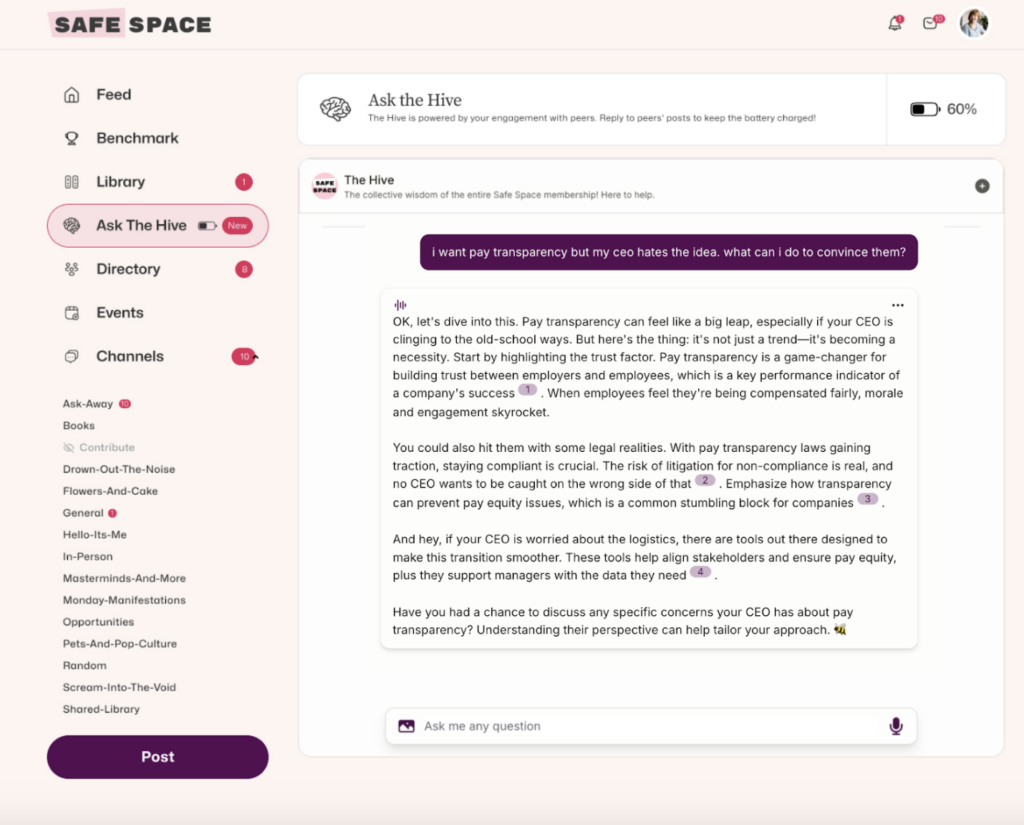

People are using AI as their therapist, BTW.
*Cue internal screaming*
That almost sounds like a joke, but unfortunately, it’s become an actual coping mechanism for some folks!
But honestly, that tells you everything you need to know about where we are with well-being right now. 😒
I feel like the pandemic cracked this open in a way that couldn’t be ignored, and a few stats make that painfully clear:
- More than 4 in 5 workers report experiencing at least one mental health symptom
- More than half of U.S. adults have at least one chronic health condition
- More than half of consumers say their financial situation is actively getting worse.
This is your workforce, showing up every day carrying all of that!
🚪Because no matter what your CEO or exec team says, employees can’t magically leave any of their feelings at the door. I always hated that phrase, ick!
When employers choose not to invest in the well-being of their employees, they may as well be saying “that’s your problem, not ours.”
That’s bad ethics and bad business.
Today I’ll be sharing some of the juiciest things I learned from WebMD Health Services’ Evolving ROI of Employee Well-Being report.
📣 The data is overwhelming: orgs that invest in comprehensive well-being programs see major improvements in productivity and retention over time.
People stay places where they feel genuinely cared for, and leave places that treat them like headcount.
It’s really that simple!
Okay, enough ranting.
Now, I want to make the case that keeping your employees happy and healthy isn’t just the nice thing to do…it’s one of the highest-ROI moves your org may not be taking seriously enough.
Maybe Well-being Shouldn’t be Thought of as a Perk Anymore

When you think of well-being at work, what comes to mind?
Far too often, it gets reduced to things like a free therapy app that nobody even uses, a meditation corner in the break room, or a plug for the EAP. 🥴
📣 Well-being should be thought of as a type of care that covers the whole person.
Physical and mental health should both be a part of the discussion, and when you look beyond a simple black and white approach, that also includes things like financial security, social connection, the ability to take time off without being shamed for it, and the overall relationship someone has with their work.
Think about it this way…you can offer someone a gym membership, but if they’re drowning in debt, they’re probably not showing up to the gym.
You can offer mental health days, but if someone is burned out because their workload is unmanageable, a Tuesday off isn’t really solving anything.
The most effective well-being programs address the ✨ full spectrum ✨ of what makes humans functional, and they do it in a way that’s woven into how people actually work, instead of being bolted on as an afterthought.
Wanna know what the full spectrum looks like in more detail?
🤓 WebMD Health Services has a white paper here that breaks down the state of employee well-being in 2026, and if you’re a total data nerd like me, there are plenty of stats in there for support!
Well-being and Business Outcomes Aren’t Separate Conversations

I gotta admit, I’m a little exhausted that we still have to justify investing in HUMAN BEINGS at work.
Like…our whole M.O. is the humans!
The people make up the business!! There is no business without the people!! How many more ways can I scream about how important the people are???
I’m probably preaching to the choir here, though, but these stats from WebMD Health Services’ report paint the idea pretty clearly:
- Employees who feel genuinely cared for by their employer report 56% higher engagement and 37% lower burnout
- Happy employees are 13% more productive than their less satisfied counterparts
- Over 90% of employees say they value their well-being as much as their compensation
- 57% say they’d consider leaving their job for somewhere that supports it better
More than half of your workforce is essentially telling you to get serious about this, or they’re out.
🤯 McKinsey (yes, those consultants who care about $$ and business value) estimates that improved employee health and well-being could generate $11.7 trillion in global economic value.
Yes, trillion with a T!!
Companies that consistently invest in the health and safety of their employees outperform the S&P 500, both short-term and long-term.
But the ROI story doesn’t stop there.
WebMD Health Services has seen long-term, strategic well-being investments translate to a 3:1 ROI for orgs willing to do the work!!! One long-term client saved $207 million in cumulative healthcare costs over 15 years.
Retention is a massive piece too: 47% of workers say wellness benefits make an employer more attractive in the first place.
❤️ And as much as I love all the data, you probably don’t need any of it to understand that employees show up differently when they feel physically well and mentally supported.
If you’ve ever had a team member going through something hard, you know exactly what I mean. The investment you make today pays out in ways that are sometimes hard to trace back to a single program, but that doesn’t make them any less real.
I think the reason a lot of well-being programs fail is because they’re treated like a one-time fix instead of a long-term strategy.
❌ You can’t run a sleep challenge in January and call it a well-being program!
Strategic investment that’s aligned to what your people actually need is where the returns show up.
Finding the Metrics That Accurately Tell the Story

Realistically, you can’t know if your well-being initiatives matter unless you’re measuring the right things.
This is where a lot of HR leaders get stuck, either measuring EVERYTHING and drowning in data that doesn’t tell a coherent story, or measuring nothing and defending a budget with vibes alone.
🔎 So let’s fix that, starting with the metrics.
The easiest way to think about well-being measurement is in layers, and each layer tells you something different.
Early indicators tell you whether people are even aware of and engaging with your programs at all.
Think participation rates and how satisfied people feel with what’s being offered. If nobody’s showing up, the rest doesn’t matter!
➡️ From there, you want to look at whether or not those programs are changing individual behaviors.
Are lifestyle risk factors shifting? Are burnout scores moving in the right direction? Do employees believe their org actually cares about them?
That perception piece matters more than most people realize!
Then, it’s about scale. Are those individual changes showing up at the organizational level?
That’s where you look at recruitment difficulty, time-to-fill, and how long people are actually staying once you get them in the door.
And finally, the long-term indicators are where the real business case lives, which would be things like healthcare costs, profitability, stock performance, and brand reputation.
Yes, these take time to build, but they’re also the numbers that make a CFO stop scrolling!
I’d say the biggest challenge is having a ton of data, but not having a framework for connecting it into a story that leadership responds to.
There’s Way More Data in the Report, and You’re Going to Want It
It’s a pretty safe bet that your people are carrying a lot right now, whether they express it or not.
The orgs that recognize that simple fact and do something about it will be the ones winning the long game.
If you’ve made it halfway through 2026 without doing an honest check-in on your well-being initiatives, now’s the time! 😉
You and I both know how deeply important well-being is to an org from top to bottom. The research is unambiguous on it, after all.
The question is whether your org is treating it like the long-term strategic investment it is, or like a checklist item that gets renewed every January and then ignored the rest of the year.
If you’re ready to build an ROI story that speaks the language your leadership team responds to, I recommend downloading a copy of WebMD Health Services’ report that we went through a little bit of today!
The Evolving ROI of Workplace Well-Being covers the business case, the exact language to use in budget meetings, waaay more data than I could fit here, and a useful 5-step process for communicating your program’s value to anyone who needs to hear it.
It’s free, and it might honestly be one of the most useful things in your toolkit right now! 😎